


Welcome to the sixth edition of Trafalgar’s Data & Decision Insights, celebrating our first year of Trafalgar Analytics.
Over the past year, we have been building the newest data analytics and research centre on the British Right, at the intersection of data science, economics and political science.
Our gratitude goes to all our Associates, industry insiders, and guest writers, who have contributed towards this team effort. Most importantly of all, we thank all our readers, subscribers, and supporters; without you, our work would not be possible.
At Trafalgar, our premise is that very often those outside the rigmarole of party politics (from data science, engineering, finance, independent commentators, to the humble ‘anon’) have uniquely insightful observations and thought through solutions to the problems that ail Britain. Ultimately, we are interested in how ideas are packaged and presented, in a way that policy makers and the public find easy to absorb.
For us, problem solving, policy making, and public opinion shaping is as much an art, as it is a science, and we will never lose sight of this.
As to our achievements of the last twelve months:
Over 20 public and private papers;
Over 410,000 views;
Our work has crossed the desks of councillors, staffers, MPs, GB News and Telegraph journalists, as well as alternative media, including TalkTV, the New Culture Forum podcast, and the Lotuseaters show.
Our most read publications have been (1) our Curtis Yarvin interview, (2) our systematic review paper of the Rape Gangs Scandal, (3) our paper on DOGE & Council Efficiency with freelance journalist, Charlotte Gill.
Particular credit for our extensive volume of work, goes to every contributor and Associate across our six constituent teams: (1) Economic and Growth Team, (2) Law and Justice Team, (3) Elections and Polling Team, (4) Security and International Affairs Team, (5) Data and Decision Insights Team, and (6) our In Conversation Team.
We take this opportunity to also thank our Design Editor, and Associate, Bukes, for leading Trafalgar’s rebrand over the last six months. As such, do check out our new website!
By the next General Election projected for 2029, the country will likely witness the greatest socio-economic and political realignment of our lifetimes. Today, every income decile of the population is resentful of the economic settlement, and the social fabric continues to fray.
If the Right successfully redraws a new, fair and sustainable social contract, it needs a compelling national story (with the crucial facts, data, and human capital) to be presented to the British public. Given this, at Trafalgar Analytics, we are committed to playing our part at this critical juncture of Britain’s history and securing its future.
Agenda for this Insights Briefing
1. The Ship of Theseus: Addendum on House of Lords Reform, the Hereditary Peers, and Danny Kruger, by Bukes, Associate, Elections & Polling Team.
2. May 2026 Election Predictions, by Mr Bobo, Psephologist and Trafalgar Associate.
3. In England’s Green and Reform Lands, by Bukes, Associate, Elections & Polling Team.
4. Economic Sanctions: A turning point in America-China Relations? by the Economics & Growth, and the Security & International Affairs Team.
5. Jack Dorsey if you can hear us please save us! by Jack Hadfield, respected newsman & Friend of Trafalgar.
6. The Posting-to-Policy Pipeline: an assessment, by Haryan Glaeddyv, Associate.
7. Editorial Contributorship Review 2026. Panel Chair: Greggs Patriot, Associate (Data Science).
8. What is next for Trafalgar Analytics? by Eulipotyphla, Associate.
If you enjoy this Insight, do follow Trafalgar Analytics and like, comment, or share our work with friends and family!
Thank you for reading,
Euli & Team
Trafalgar Analytics, 5 th May 2026

1. The Ship of Theseus: Addendum on the House of Lords, Danny Kruger & the Hereditary Peers
By Bukes, Associate, Elections & Polling Team
Being cautious and being audacious both bear fruit in their own times as necessary. When it comes to Reform UK, there are people within the party who err more on the side of caution and others on the side of audaciousness. Danny Kruger, the Reform MP responsible for the party’s preparing for government unit, belongs to the former category. This is understandable, given that Danny until recently was a ‘big C’ Conservative and still is a ‘small c’ conservative. Speaking to James Heale of the Spectator, and more recently George Spencer of the Pimlico Journal, Kruger outlined his general assessment of the task at hand, with regards to the House of Lords.
Before we assess the salient points of his interviews, we are encouraged by the fact that Danny did not float the reinstating of the hereditary peers. Their removal is the equivalent of the last original plank of Theseus’ ship being removed, and strengthens Nigel Farage’s arguments and public statements that our Upper House is filled with Blair’s and Cameron’s appointees (cronies).
Going forwards, preserving the sanctity of the appointed Life Peers simply does not carry the same weight as preserving the Hereditary Peers. Keir Starmer has done Reform two favours by removing this factor from consideration: (1) many of the loudest peers have been unbelievably lazy and did little to speak up in face of Britain’s decline, and (2) Reform can appoint fewer peers to gain an effective majority in the House of Lords.
To take an example on Point 1, Lord Strathclyde (Conservative) has recently done a lot of media appealing to the public to keep him in office. But a quick search of Hansard reveals that 2012 was the last time he mentioned either “crime” or “immigration”, some 14 years ago. It is somewhat incredible to think that these issues have eluded him over this period. As to Point 2, the removal of the last 92 Hereditary peers improves the parliamentary arithmetic for Reform (see Exhibit 1), and given Point 1, there is little reason to bring them back into the Blairite consensus of 1999.
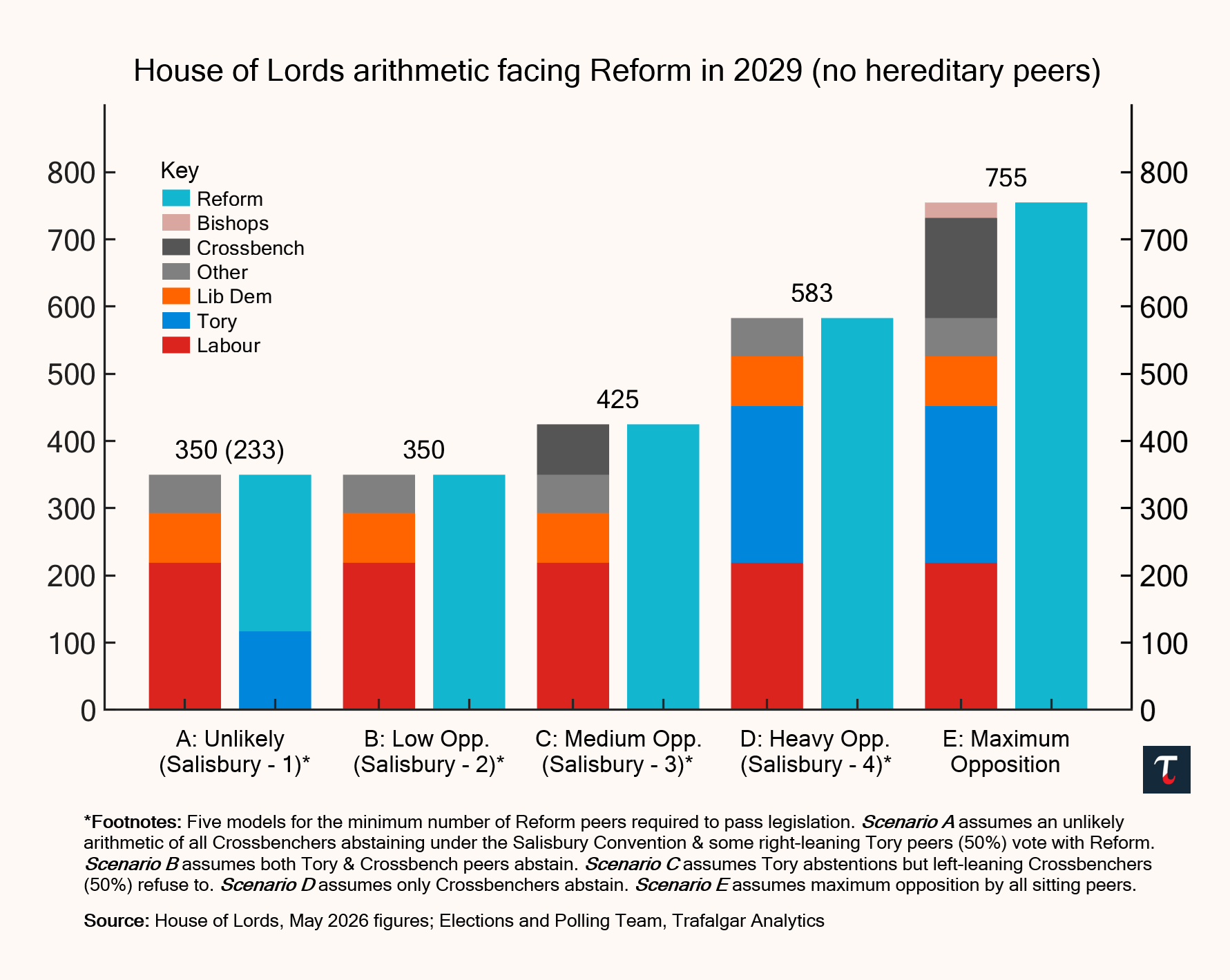
Should Reform win a majority at the next general election, it will want to have legislation prepared and able to be passed through both Houses of Parliament as quickly as possible. To achieve this, Kruger’s broad calculation for what will be necessary to achieve this is, as follows:
1) Make Reform UK’s General Election manifesto as comprehensive and as detailed as possible, so that the House of Lords cannot pretend X policy was not part of their electoral mandate – thereby ensuring pressure through the Salisbury Convention is not loosened.
2) Empower the House of Commons, with a look at undoing the Robin Cook reforms to committee procedure – thereby circumventing calls from the House of Lords for further scrutiny from their own chamber being necessary.
Kruger makes clear this is just his own view, admitting that there is still debate had within Reform UK on what to do. Abolition of the House of Lords is still supposedly being considered. Were Reform UK to follow Kruger’s strategy, it would still need to plan for the scenario in which it fails to deliver on its intended outcome, i.e. smooth passage for their legislative agenda. His premise relies on the establishment following tradition and caring about the will of the British people, as expressed at the ballot box. As we have seen for much of the post-war era, our political elite has shown little interest in either.
Kruger asserts that to begin with, attempting to abolish the House of Lords would take too long and delay essential work needed legislatively. But this might be the case, regardless of when such Parliamentary reforms are embarked upon.
If you come to the conclusion that Lords reform is necessary, the consideration should be first and foremost: what triggers it, and how it is justified, and how soon it can be achieved.
There is:
Scenario A) Reform UK commits to House of Lords reform in their manifesto, with an explicit and clear choice made on what is to be done to it (the most credible options -stack, replace, abolish- with their advantages and disadvantages have been outlined by Trafalgar Analytics, earlier this year), and then the Lords attempts to block said reform.
Scenario B) Reform UK does not commit to House of Lords reform in their manifesto, believing that with enough pressure elsewhere plus the Salisbury Convention that the House of Lords will pass their agenda over the next 5 years, and then the Lords attempts to block said agenda.
Not to labour the point, but to ratchet towards House of Lords reform from a position of not having campaigned on it (in light of political opposition to your agenda, wrong as it might be) will be harder to justify to the general public than if you begin from such a position before the election takes place. Kruger may be correct, perhaps the establishment will not behave combatively towards a Reform Government, and if so, it saves the party a lot of time. But if he is wrong, defaulting to the insurance policy of Lords reform after, could cost more political capital than simply going ahead with Scenario A in the first place.
Stacking the House of Lords with hundreds of apparatchiks at the breaking of the legislative fire alarm glass (midway through a parliamentary term) may look more authoritarian than beginning on Day 1 with parliamentary reform, justified in isolation. It could darken public views on any legislation Reform attempts to pass afterwards (no matter how benign the bill might be). The journalist class is part of the establishment too, and they hold unaccountable power over the country just like peers in the House of Lords, yet shielded by the impervious “free and democratic country” mantra. They will spin anything and everything Reform does as wrong, destructive, evil, and worst of all, reversible.
We would not call Kruger’s sympathies naive, as he is very much aware of the difficulties Reform will face, whether in handling the civil service or Westminster, but the scenario must be further analysed to ensure Reform’s long term success. Reform must be able to make changes that become accepted in the new political consensus. If Reform is to shape the country in a permanent way like Tony Blair did on the minimum wage, on the Supreme Court, on the House of Lords, ad infinitum, it has to win the overwhelming public narrative. In this regard, any hesitation, indecision, u-turning, or reactive policy making, will damage Reform’s ability to ensure that its legacy lasts long after its term in office.
2. May 2026 Election Predictions
By Mr Bobo, Psephologist and Trafalgar Associate
Editor’s note: This piece aims to surface data insights and a wealth of knowledge on the Online Right that is often overlooked, and in this case, the psephologist Mr Bobo (@Mrbobo972407) explores how the predictions of the anons differ with the ‘official’ pollsters.
As my 2026 May Local Election projections -see Exhibit 2- have attracted some modest attention, I shall take the opportunity to explain them lightly here. My general method involved applying a simple proportional swing to the 2021-22 local election results, using the 2021-22 local election results and the 2024 ward maps (New Statesman) - to determine party support in each area with a focus on Reform, who has previously stood in very few seats. As such, it is worth prefacing that I am not a pollster by trade, but just a political and data enthusiast. That being said, my projections have ended up very similar to that of fellow anon, Deuxvingarian, who has published his own much more granular model.
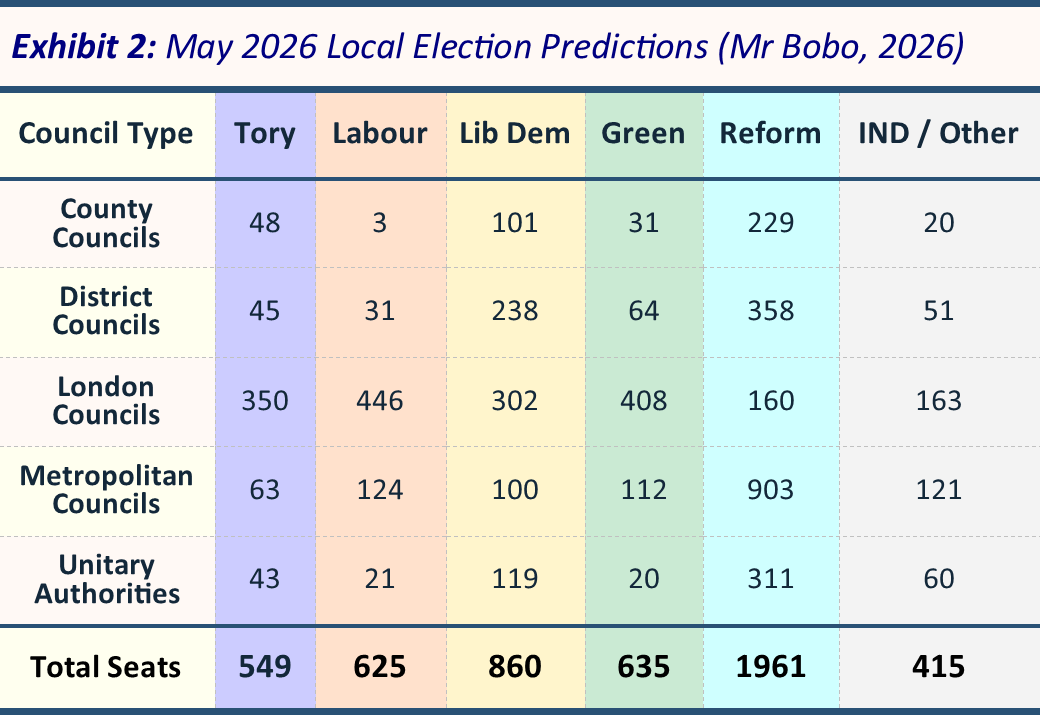
So what is looking to happen? Well, in short, Labour is looking at a disaster. My projection has them losing 1600 seats, and honestly, they may do even worse. They’re losing voters left, right and centre; they’re losing Muslims, they’re losing students, they’re losing the White working class, they’re losing Remainers, they’re losing Leavers. At this point, it would be easier to identify and explain who they’re largely keeping: the high-income white population, as well as more loyal minority groups, including the Black and Sikh population, who now comprise the largely 18% or so of people who, for now, are sticking with Labour. However, it is very likely that turnout among these groups will be quite poor, and accentuate Labour’s losses. We can expect Labour to lose between 66-75% of their currently-held council seats this cycle.
The Conservatives are in an interesting position. It is likely they will lose between 50-60% of their seats, totaling to around 600 losses. They seem resigned to this, so much so that a 1-2% rise in the polls has led to much talk about a ‘Kemi Bounce’ among the commentariat. At the time of writing, the Tories are polling around 18%, near their floor, although Kemi’s ratings have indeed improved quite substantially since the 2025 Autumn Budget. Nevertheless, they are also poised to do quite badly in county councils across the shires of England, losing to Reform in Essex and East Anglia, and the LibDems in Sussex and Surrey.
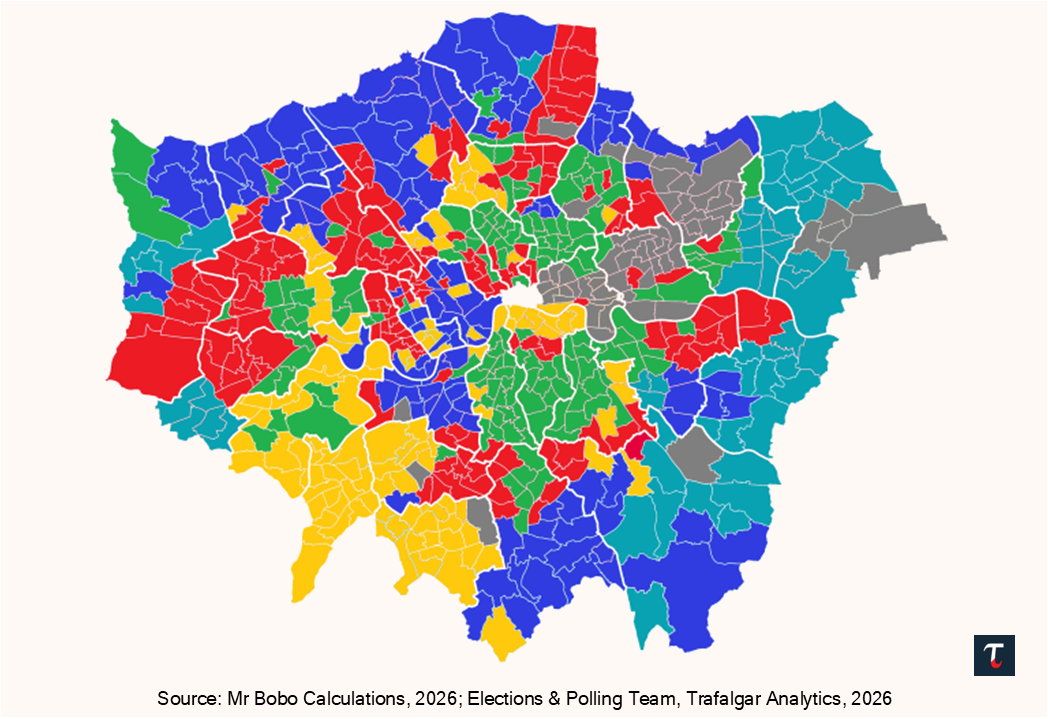
The only bright spot for the Tories is ironically London, see Exhibit 3 below. Due to their urban coalition of wealthier liberal-remainer Tories and ethnic minority groups such as Jews and Hindus, they look likely to hold onto these groups more effectively than working-class leave voters. It is in London where the Tories are likely to take limited losses here, and we should not be too surprised if they were able to make a net gain of seats here. If they can take back Brent, Wandsworth and Westminster councils from Labour, and limit their losses in London to under 60 seats, that could at least give Badenoch something to point to, to strengthen her leadership, even with poor results in the rest of the country.
The biggest winners of the May 2026 local elections will be Reform. But the jury is still out on the scale of this victory. Britain Elects gives a ‘central’ estimate of 1689 seats, with conventional wisdom among the mainstream pollsters suggesting a lower bound of 1,470 and an upper bound of 1,892 seats. Interestingly, the anon right believes Reform will outperform even the upper bound, with my own estimate of 1961, and Deuxvingarian’s at 1953, see Exhibit 4. The scale of the Reform victory versus the scale of the Tory loss will be the biggest indication as to whether Nigel Farage is right that “The Tories will cease to be a national party after May 7th”.
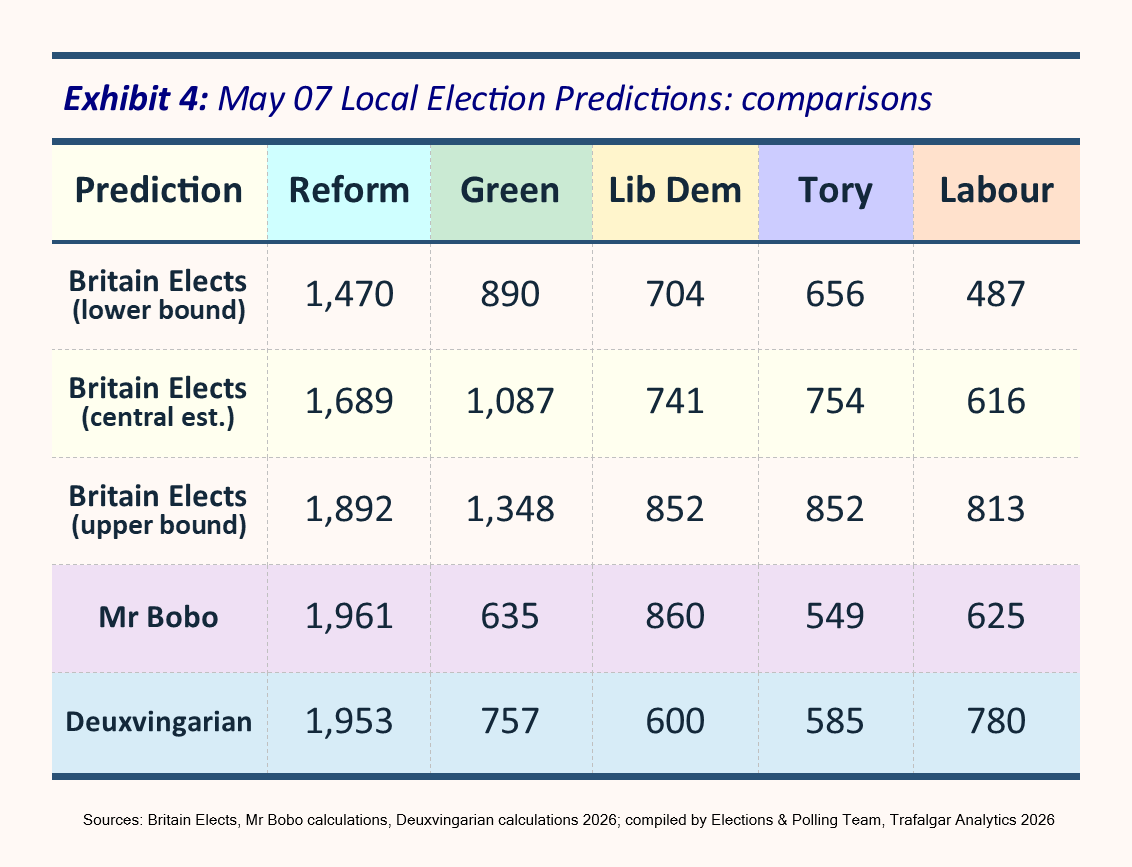
So what are the trends across the board? The anons predict that whilst Reform will outperform the predictions of the mainstream pollsters, with the Greens and Tories underperforming, and the Lib Dems and Labour performing more or less in line with expectations.
To briefly touch on Wales and Scotland. The anons do not differ with ‘received wisdom’ too much. Plaid Cymru are looking tied on vote share with Reform, though I predict a Plaid win. However, with the Greens and Labour as minor parties holding the balance of power, Reform will likely become the official opposition in Wales. In Scotland, the SNP are ahead, some predict that Reform will comfortably take second, whilst others think Labour and Reform are vying for second. It is too close to call, but Reform coming second would be a turning point in Scottish politics, allowing it to establish itself as the principal Unionist party and the official opposition.
As with all elections, it’s not over until the polling stations close their doors, so happy voting on May 7th!
3. In England’s Green & Reform Land
By Bukes, Associate, Elections & Polling Team
If the story in British politics of 2025 was the cementation of Reform UK as the pre-eminent opposition party, then the story of 2026 might well be of the Green Party’s emergence as a credible competitor to the Labour Party. The comparisons to one hundred years ago have been overplayed since the 2024 General Election, with the usual parallel and perpendicular lines drawn for how Reform’s rise is similar and different to that of Labour’s in the 1920s. But the same is yet to be done with the Greens. That not one, but two, of the parties which make up our two-party system could be erased, might be too bewildering a possibility for people to accept just yet.
Even with most polls currently showing a greater cataclysm awaiting the Labour party, it is the Tory party which is assumed to be dead upon Reform’s presumed election victory. Nevertheless, Reform UK has plateaued, and has generally begun to dip since the beginning of the year, see Exhibit 5. This does not call for exclamations of “collapse” or told-you-so tutting from detractors, for politics is a long game of chess for which the only move that matters is the winning one. The opinion polls are not the election. But, it is still worth thinking about what Reform might wish to do, or need to do, in its approach to the Green Party, now that it is a serious contender.
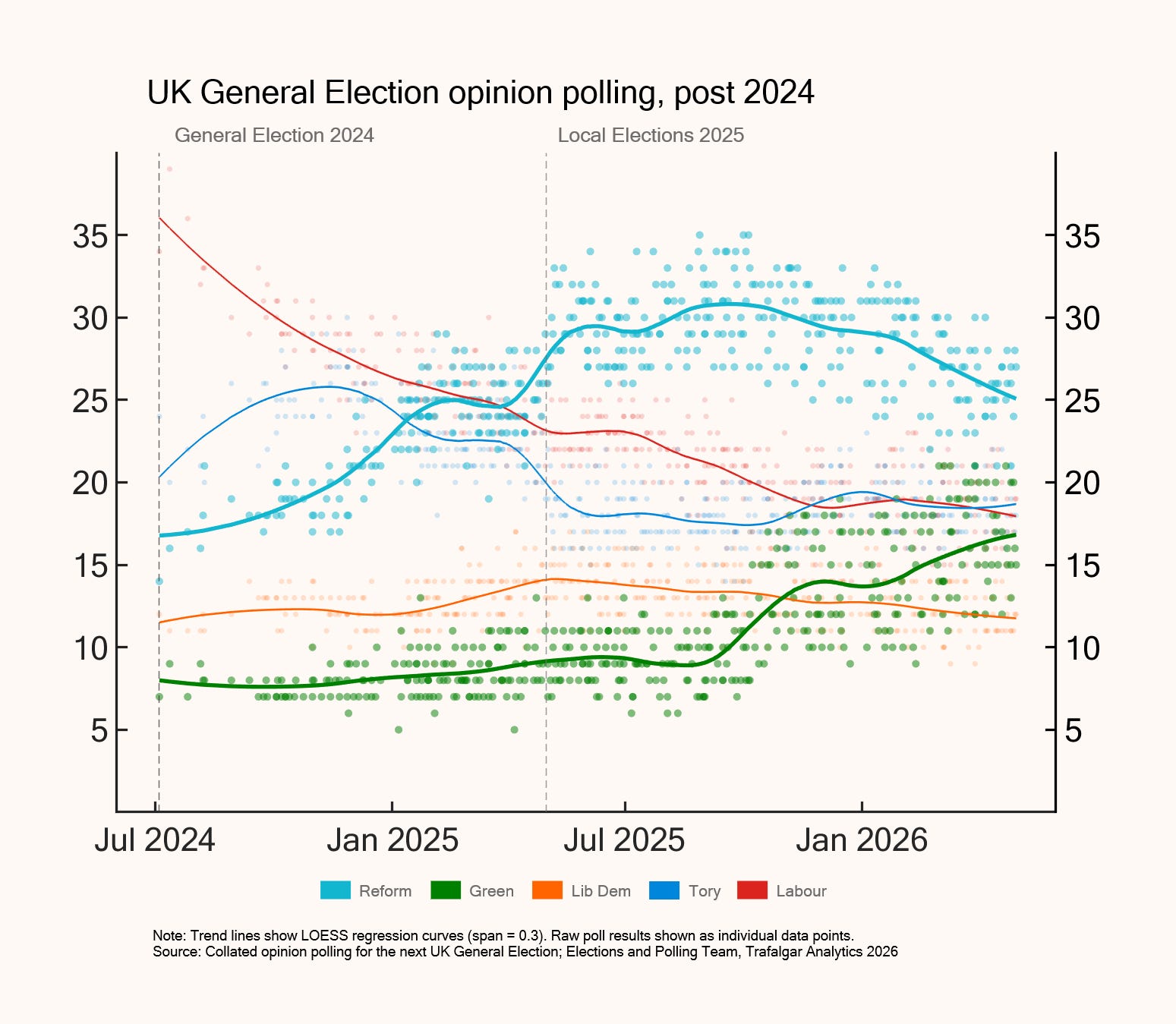
In an age when the British public wants vengeance rather than fairness, the loudest voice in the room calling for an alternative vision, any alternative vision, can win large portions of the electorate. Whilst Reform has captured enough of the British public’s imagination to become largest party by polling for over a year, it is the Green Party which is currently capitalising most on this sentiment.
Irrespective of the views of the Times or the Telegraph, to look ‘strong’ on the economy in the eyes of the public increasingly means proposing a whole range of policies and reforms that could cause chaos and instability. Having anti-establishment positions on the economy, and being lambasted for those positions in the press, is doing a great deal of free advertising for the Greens. Playing on a supposed lack of ‘costings’ for hypothetical Green budgets will not work, because such considerations are neither conceived of nor cared about by a general public that is struggling to get by. They have their own direct, personal ‘costings’ to be dealing with and are naturally finding the notion of state intervention appealing - be it through wealth taxes or rent controls. Reform may rightly want to look credible on the economy, they will likely form the next government after all, unlike the Greens, but this does not mean it must tack towards a Hunt-Reeves contemporary orthodoxy.
Some things Reform can do in light of these points:
1 Attack the Green Party more, but take them more seriously
There is growing public sympathy for their positions on the economy and foreign policy. Whilst current attack lines that talk of them as a cabal of lunatics who have escaped the asylum has been good red meat, the base was never considering voting Green anyway. If Reform addresses them as if they are an equal, the credible anti-establishment left-wing equivalent, this can play to Reform’s hands. Reform should seek to solidify the Greens in the eyes of the left as the ‘real’ opponent that Reform truly fears. Not only does this make it crucially harder for Labour to restore its electoral coalition, but it will also give Reform the opportunity to explore its own answers to the issues facing voters in a different and freeing way.
Totally dismissing the Greens might otherwise push Reform closer to the other parties in the minds of the average voter. If the attack lines against the Greens resemble the ‘uniparty’, Reform risk being perceived as one of ‘them’, especially if voters start to identify Reform with policy positions that will not directly benefit them.
2 Answer the issues people are facing in ways the Uniparty is not
If the Green Party’s solutions are unworkable or destructive, what is Reform’s alternative? It is not enough to countersignal a solution that has not been tried against a backdrop of current policy failures. People will gamble on change due to the present strains they are under and that will only get worse in the months and years leading up to the next general election.
The impetus to vote for Reform also applies to the Green party. People are more receptive to policies and ideas that run contrary to establishment thinking. As I outlined in January, the less Reform sounds like Labour and the Tories on the economy the better. To the struggling and wavering voter, the more Reform is attacked as unsuitable custodians of ‘the purse strings’ by those currently in power the better.
Right now, only the Green Party is proposing a radical alternative on the economy – but it really does not, and should not, have to be this way. Reform has both the electoral coalition and post-2024 polling mandate to offer something more radical. After all, the Brexit coalition (of 2016 and 2019) won the day, because it offered an alternative: ‘Levelling up’ for the ‘left behind’ and ‘the Red Wall’. What fresh economic vision does Reform want to present in the lead up to 2029?
3 For now, move on from the Tory squeeze manoeuvres
The closer Reform tries to align with the entrenched Tory voter (in the hopes of a more full absorption and integration of ‘the right wing vote’) the more they will lose out on potential voters who do not fall under that loose description. Many people will continue to vote Tory, especially because of how similar they sound to Reform. It may sound backwards, but Reform will probably be able to swing more Tories towards them by sounding less like an offshoot and more like something new. The real fruit lies on the far larger tree of the average, apolitical voter, not on the twisted branches of the old Tory coalition.
Lack of trust in the Conservatives and Labour has gifted Reform a massive amount of support, but elevation back into the 30-35% polling range will come by widening the coalition with heterodox policy proposals targeted at different voters. The framework I present above is driven by my desire for Reform to win, and consign both the Labour and Tory parties to history. In 2026, we have increasingly heard people (rightly or wrongly) say that they feel that Reform will be more of the same. The public will need to hear more reasons why this is not the case, before the party is able to break through the 40% range, which it needs to win a clear majority.

4. Economic Sanctions: A turning point in America-China Relations
By the Economics & Growth Team, and the Security & International Affairs Team, Trafalgar Analytics
In the quiet hours of Saturday 2nd May, the bilateral relationship between the United States of America and China took a pivotal turn. A week prior, the US sanctioned China’s principal five “Teapot” Refineries, for (allegedly) transacting with sanctioned Iranian oil. China’s response was to declare that (1) the sanctions were ‘blocked’, (2) anyone recognising, enforcing or complying would be doing so against Chinese law, and (3) any Chinese company suffering losses could take any entity to court in China.
For avoidance of doubt, such an action has never happened before this point, and at the time of writing, its reverberations have yet to be felt across the world.
American power is often misunderstood and commonly underestimated. Claims of its waning power are often incorrect. America’s power comes not from its military or diplomatic might but from its economic might, and primarily so. We are all aware of the size of the American economy, its consumer market, its tariffs regime, and the power of the dollar (which most of the world’s trade is conducted in).
The tariff policies enacted by the second Trump administration last year demonstrated how America could apply blanket pressure to bend allies and rivals to its will. However, the average member of the public is usually much less aware of how American economic power can be wielded in a very specific, targeted and powerful way, through sanctions. What gives sanctions this reach is not a direct prohibition on the target alone, but the threat levelled at everything around it: any bank or business that continues to serve a sanctioned country or individual risks being locked out of the American financial system entirely. It is a consequence so severe that institutions worldwide comply without hesitation.
One famous target in recent memory was Carrie Lam, the former Chief Executive (head of government) of Hong Kong. Prior to her fall from grace from the international community, Carrie was a Cambridge-educated former British citizen. However her handling of the Hong Kong protests of 2019-2020 brought her into direct conflict with America. By August 2020, she was sanctioned by the American Government. This means that nobody who does business with Carrie Lam could do business in America. As such, not a single bank, international or even Chinese would provide her with a bank account, lest they breach sanctions. Thus, her roughly $5.2 million HKD ($672,000 USD) per annum government salary had to be paid in cash.
“I am using cash every day for everything. I have piles of cash at home because the government is paying my salary in cash.”
At the time, one foreign affairs commentator made the joking analogy: to understand America’s true power, it would be if a Second Century Roman Emperor decreed that a minor king of a Persian vassal state would henceforth be only paid in wool, instead gold. 6 years on, Carrie Lam continues to be sanctioned. American power is very real, and is arguably the most powerful nation state to have ever existed in human history.
In this light, the events of May the 2nd are pivotal to our understanding of Sino-American relations. The usual Chinese responses to American sanctions have been:
(1) some kind of angry denouncement, followed by,
(2) counter sanctions.
Invariably, it is mostly symbolic. Unlike American sanctions, which sever targets from the world’s reserve currency and its attendant financial infrastructure, Chinese counter-sanctions land on individuals who have no meaningful exposure to Chinese banking, Chinese markets, or Chinese territory. The designation is, in effect, a statement of displeasure dressed as a legal instrument.
Since 2021, China has passed four new laws the 2021 Blocking Rules, the Anti-Foreign Sanctions Law, the Regulations on Countering Unjustifiable Extraterritorial Jurisdiction, and most recently two State Council Decrees issued in April 2026 (on supply chains and foreign extraterritorial jurisdiction). The implications of these have been unknown, because China has not used these laws once, until now. So what does it mean for us all?
The blocking action in relation to the Teapot Refineries creates real legal consequences, any bank or business that recognises or implements the American sanctions would now be in breach of Chinese law. Conversely recognising Chinese Law, would put any bank or business at risk of breaching American law. It is an all-round incredibly uncomfortable legal quagmire for any international corporation to be caught up in.
The potential relief to unblocking and deescalating this could lie in the Xi-Trump Beijing Summit on May 14–15. What to watch in the weeks ahead is threefold:
1) Whether international banks quietly continue to comply with US sanctions regardless.
2) Whether the upcoming summit provides cover to face-save for both sides.
3) Whether any Chinese firm brings a lawsuit under the new mechanism to seek losses.
Each of these will tell us something different about whether May 2nd was a turning point in name only, or whether we are entering a new phase following unipolar American hegemony. If we are indeed entering a multipolar world, readers should be following these developments in international relations and the global financial order closely.

5. Jack Dorsey if you can hear us please save us!
By Jack Hadfield, respected newsman & Friend of Trafalgar
At the end of this year, I’ll be turning 30. A scary thought for many, yet I already consider myself to be a true oldhead. The internet that I grew up on -was radicalised upon- is done and gone.
I was there for the halcyon days of GamerGate, for the 2016 revolutions, and it was a tough fight to be a rightist online, let alone someone with a face account. I had to choose my words very carefully when arguing with an SJW on Twitter dot com, lest my entire account go up in flames at the hands of the Dorsey regime of terror. On Facebook, you couldn’t even mention certain words, or you would be “Zucc’d” in a heartbeat.
We fought on. Many of my friends would have to come back and respawn time after time, but never gave up, because we could tell the influence that online politics was having. The internet IS real life, or at the very least, upstream of it. Trump and Brexit were the first confirmed indications that the fight here mattered out there.
So when Elon bought Twitter, when Zuckerberg let the Reels algorithm off the chain, and I realised that myself and my ideas would not only no longer be suppressed, but be promoted, I was overjoyed. We’ve won the war. Surely now, the online world would be a flurry of productive, intellectual conversations, dominated by those who led the charge against #TheWoke.
I couldn’t be more wrong. What happened instead is that the masses, like the SJWs on the other side back in the day, had now been fed a raw diet of Hyperborea and red squirrel memes. The new generations did not come to our side because they saw in front of their eyes the collapse of civilisation, or thought long and hard and engaged in critical dialogues with those they opposed, but because it was the prevailing conversation within their social circles. This is true for both the recently radicalised boomers and zoomers.
None of these people have any idea how good we have it. They have come onto the scene based on an online world that we have carefully created, and don’t appreciate the Eden that it is for the right. If iron sharpens iron, the blade of the online right is becoming dull. You start posting the most low IQ, sloppy, “patriotic” content, and suddenly you’re an e-celeb, and you’ll keep your account and your Elonbux forever. There is no law of the jungle where the Twittermod lion occasionally comes in and eats you and your friends, so you have to start again.
Is this an argument to return to a more censored internet? Perhaps. We were still able to push the conversation very successfully under harsher conditions. I worry that with our natural predator arrested and executed, the dissident right gazelles will eat all of the grass on the savannah, and we will collectively starve to death.


6. The Posting-to-Policy Pipeline: an assessment
By Haryan Glaeddyv, Trafalgar Associate
Since 2020, social media has played a much more focused role for politics than in the past, far beyond slothful journalists getting their stories from the posts of politicians on X. The humble anon (anonymous account), with a keen eye for detail, and interest in specific policy, can post endlessly about issues to influence discourse and even bring about concrete policy changes.
This phenomenon has been dubbed the “Posting to Policy Pipeline” (PPP). The strategy has a few examples of success and we should celebrate this as it allows for political discourse unbound by political professionalism and common wisdom that have done no favours to the public for decades.
The most famous and successful example of the PPP was Max Tempers’ war on the Motability scheme. Simply searching Tempers’ account for Motability will reveal thousands of tweets about how the scheme became responsible for 20% of all recent new car purchases in the UK, inflated electric vehicle sales and observations of people taking advantage of the system.
Buying a new BMW with a huge discount, MOT and insurance paid for by the taxpayer led to a spurious wellbeing metric being used to justify the policy; this obviously was not well received by politicians. Richard Tice, Reform Deputy Leader, was the first politician to use Tempers’ crusade to indicate policy direction. This cascaded to the eventual removal of luxury cars from the Motability scheme by Labour, with other parties looking to take the reforms further.
The PPP has had successes elsewhere too, such as keeping pressure on Parliament to finally deliver justice for the predominantly Pakistani rape gangs that were covered up for decades. Various anons have played their part in this, but Adam Wren managed to crowdfund his own activism to get court documents published, along with his research at Open Justice UK.
These efforts have been a good driver to keep the crimes in the public discourse and helped push Labour into having regional inquiries. This has yet to result in a truly national public inquiry, though right wing parties are promising to deliver one if elected. Labour’s current efforts to run a ‘national inquiry’ with contested terms of reference, and chaired by a Labour peer, will certainly fall short.
Sometimes, however, the consequences of the PPP are far from ideal. For at least the past 12 months, migrant hotels have a persistent fixture of the national news cycle. Credit for this goes to the many anons and citizen journalists, such as Jack Hadfield, who were posting clips and news on X about the associated crimes and subsequent protests. The real core of the discontent was focused on:
(1) Illegal immigrants being in the country at all;
(2) The violent and sexual crimes being disproportionately committed by illegal immigrants.
Instead of addressing the concerns of local residents, the Government moved said illegal immigrants out of hotels and into house shares, or House-in-Multiple-Occupation (HMOs), dispersed into communities. Whilst locals have also been complaining about this too, due to the decentralised nature of HMOs, the subsequent protests and clips of tensions have been rarer. Though the Government is cagey about the data on illegal immigrant-related crime, Ministry of Justice data indicates that sexual offence convictions among foreign nationals have risen by 62.2% between 2021 and 2024, which is 58% higher than the rise among British nationals (39.2%).
The migrant hotels episode illustrates a risk with spotlighting issues online: that the PPP can be captured by policy half-measures that neutralise the visible pressure without solving the underlying problem. The PPP is not always successful, and sometimes makes no progress whatsoever. One example being the campaign for the death penalty, which social media tends to explode with support, in the aftermath of any high profile paedophile or murder case, such as the stabbing of the Southport children. It went so far that Reform MP Lee Anderson posted a picture of a noose, in solidarity. Yet this cycle of anger, advocacy for the death penalty being just the tip of the iceberg in some cases, waxes and wanes but never goes away completely. To date, no mainstream party is willing to cross the Rubicon on this policy front.
So what makes the Posting to Policy Pipeline succeed and fail? From these examples, the answer revolves around focus, detail, and messaging.
Max Tempers is the gold standard for this, he has written hundreds of tweets with a simple message, and a lot of evidence to support it, and is now focused on other policy disputes, such as the fire retardant scarecrows. Adam Wren has good messaging, but despite best efforts has struggled with missing evidence from transcripts and care records. Of course, this is not his fault at all, as he is working against a system actively covering up rape gang crimes, but it reflects the number of ingredients needed for a successful public campaign, getting from posting to policy.
As such, whilst the migrant hotels have had plenty of evidence from thousands of anons and citizen journalists, there has been no unified messaging.
Posts have tended to sporadically complain about illegal migrants:
(1) being present in hotels;
(2) costing the taxpayer;
(3) committing serious crimes.
There was no real focus on a common answer or policy. Whilst the answer is obviously deportations for all illegal immigrants; mixed local messaging on closing or moving nearby hotels, have not solved the root issue.
Finally, with the death penalty, although there is good message discipline, there is absolutely no detail on what the policy would look like and how it could be implemented. It is the clearest illustration that passion and numbers alone are insufficient; without both message discipline and evidential detail, the pipeline stalls at the posting stage.
The Posting to Policy Pipeline can clearly be put to good use and advance the goals of the Right. When committed properly, it can completely change the political discourse, but it requires very good message discipline. This may be why individual posters, such as Wren, Tempers, and the anon who coined the term “Boriswave”, have seen more success than large online groups who fail to keep the message clear and focused.
To the anon or public-facing account reading this, you too can make a real impact, if you have the right focus, detail, and messaging. One man alone in a room with a computer can change the world.
7. Editorial Contributorship Review 2026
Panel Chair: Greggs Patriot, Associate (Data Science)
As we approach our first year of publication in May, we want to thank everyone who has contributed to, read, and shared Trafalgar Analytics. In marking this milestone, we will be conducting an annual Editorial Contributorship Review of our archive, in line with UKRIO guidelines on research integrity: assessing all papers against our editorial standards, contribution records, and accuracy.
The full review guidelines may be found on our website: here.
Any reader or author wishing to submit observations or representations to the Review Panel regarding any paper in the archive is welcome to do so via email, by May 31st 2026.
Panel Contact Email: ECR.2026@trafalgaranalytics.co.uk
8. What is next for Trafalgar Analytics?
Celebrating one year of publishing is, of course, a great time to reflect on what is next for Trafalgar. Our work has been made possible by you — the readers, subscribers, and supporters of our budding data analytics and research centre. The impact that we have had, has been largely through social media and by word of mouth, and for that, we are hugely grateful.
Going forwards, we intend to build on this momentum with a mix of public and private papers in the pipeline. In the coming months, we will be touching on a range of economic and growth related topics, given the increasingly growing list of issues bubbling under the surface. We have some leading experts joining us soon, so keep your eyes peeled!
On new content: in the third quarter, we intend to start a new series of regular Trafalgar X/Twitter Spaces. It may interest the reader that a number of Trafalgar Associates first met through X Spaces and independent podcasting. When structured and moderated well, it is an exceptional medium to share and hone ideas. Equally, we are always keen to reach a wider audience, and so paired with our new research papers, we look forward to new engagement with our upcoming work.
As we draw this auspicious anniversary Insights Briefing to a close, it goes almost without saying: If you are interested in supporting, collaborating, or working with us, please do contact us, via email, Substack, or X/Twitter.
If you enjoyed this Data & Decision Insight, feel free to like and share. For further work, follow us at Trafalgar Analytics on Twitter or Substack.
Warmest wishes,
Eulipotyphla & Team
Trafalgar Analytics, 5 th May 2026
At Trafalgar Analytics, we are building the leading Data Analytics and Research Centre on the British Right.
Our expertise sits at the intersection of data science, economics, and political science.
Founded in May 2025 by engineers, finance and consulting professionals, we solve problems from first principles and inform public debate, ahead of the socio-economic and political realignment of 2029. We provide decision makers with data insights, strategy, and operational support.
As we celebrate one year of Trafalgar, we would like to thank all our readers, subscribers, and supporters; without you, our work would be not possible.