

Editorial Contributorship Review 2026
Editorial standards, contribution records, and accuracy

In line with academic best practice, our annual Editorial Contributorship Review will take place in June 2026 to review all 2025-26 publications by Trafalgar Analytics (up to 31 May 2026) in line with UKRIO guidelines: assessing all papers against our editorial standards, contribution records, and accuracy.
Panel Membership
The Review Panel is chaired by a member of the Editorial Team at Trafalgar Analytics, and has no known conflict of interest with respect to any paper or contributor under review. Where the Chair is a named co-author on a paper under assessment, they recuse themselves from scoring and voting on that specific paper, with an alternative senior panel member assuming the chair’s function for that paper only.
Panel members are drawn from contributors holding an editorial role at Trafalgar Analytics; where possible, independent members will be invited. Where any panel member —including the Chair— is a named co-author on a paper under assessment, they declare this at the outset and recuse themselves from scoring and voting on that specific paper only. All declarations and recusals are recorded in the internal minutes.
ECR Process
The Review will follow a three-stage approach. It will firstly (1) assess accuracy, in line with the CRAAP framework (Blakeslee, 2004), (2) assess authorship, in line with British Trust for Ornithology and ICMJE standards, and finally (3) a decision on the action/outcome.
Stage 1: Accuracy
Each paper is assessed using the CRAAP framework (Blakeslee, 2004) on a scale of 1–10 per criterion, producing a total out of 50.
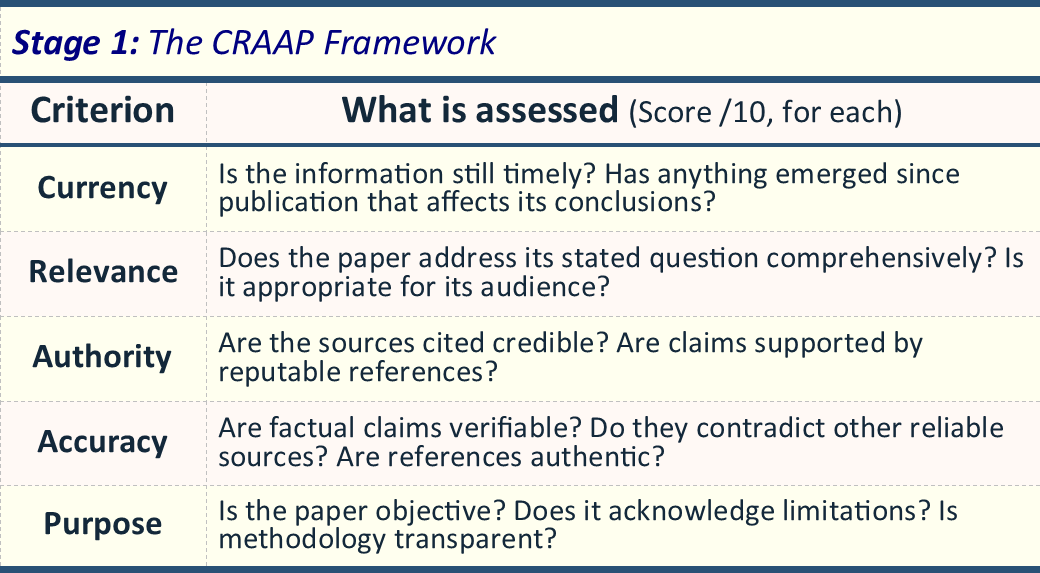
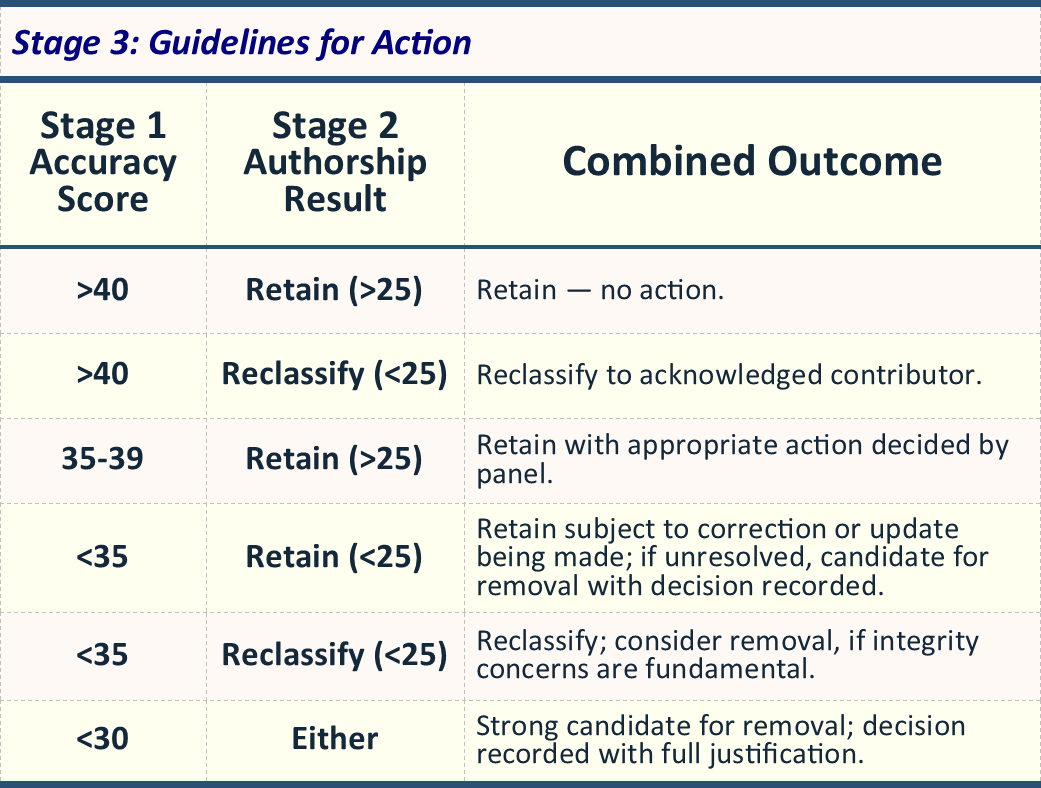
Papers scoring 40 or above are retained without action. Papers scoring 35-39 are reviewed by the panel. Papers scoring below 35 are reviewed for correction or removal, with the decision recorded and justified.
Stage 2: Authorship
“Would the paper have existed in this form if this individual hadn’t contributed?”
Guide to Authorship Contributions (BTO 2026)
This is the ultimate question to be answered on all papers, and the following process, in line with academia, allows the panel to come to their required conclusions.
“A small contribution (the ‘killer’ idea) can have a big impact, and should be credited accordingly, as should multiple smaller contributions – such as performing a series of individual analyses.
Note those who contribute to early stages of the research should automatically be invited to participate in the later stages of write-up and review.
All authors should be able to vouch for/defend the part of the paper they contributed to (which might only be a specific part in the case of e.g. data collection or provision).”
Guide to Authorship Contributions (BTO, 2026)
Stage 2.1: Scoring for each author, out of 90
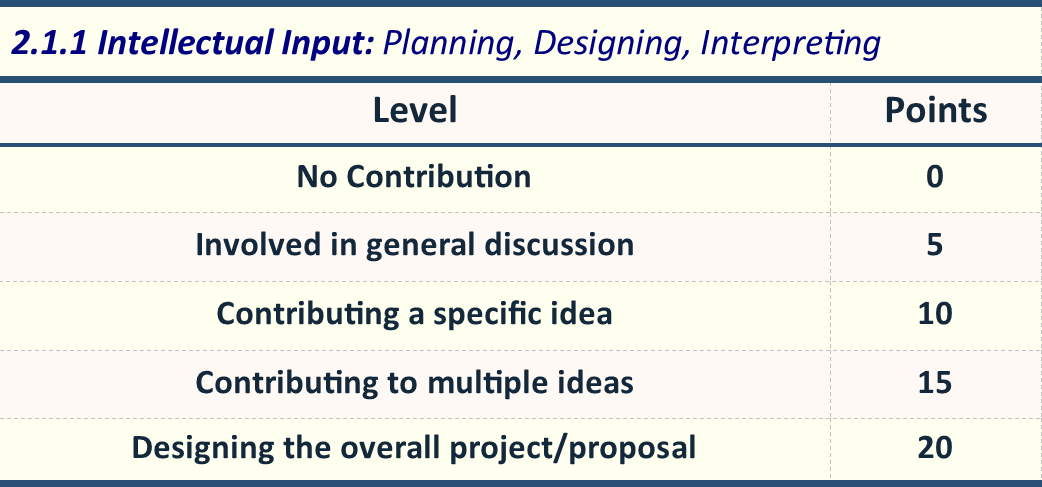
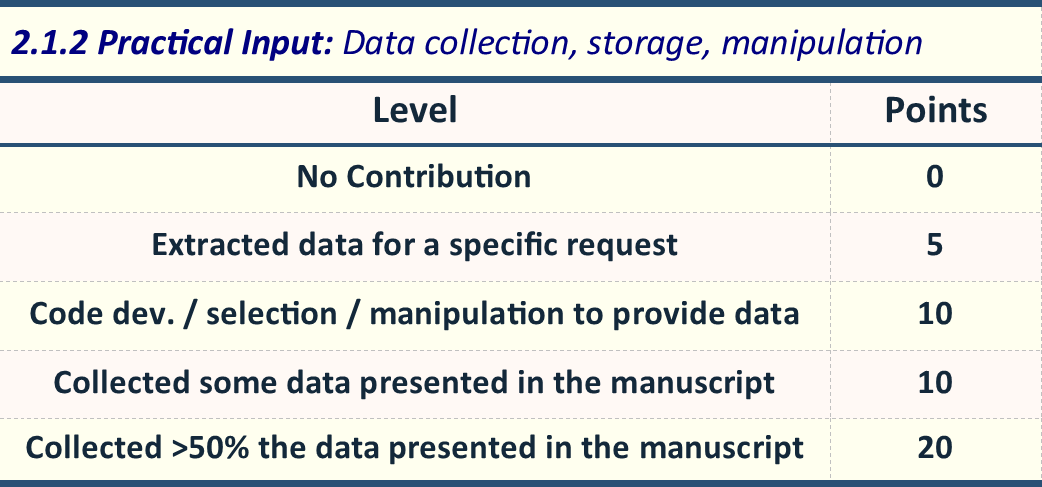
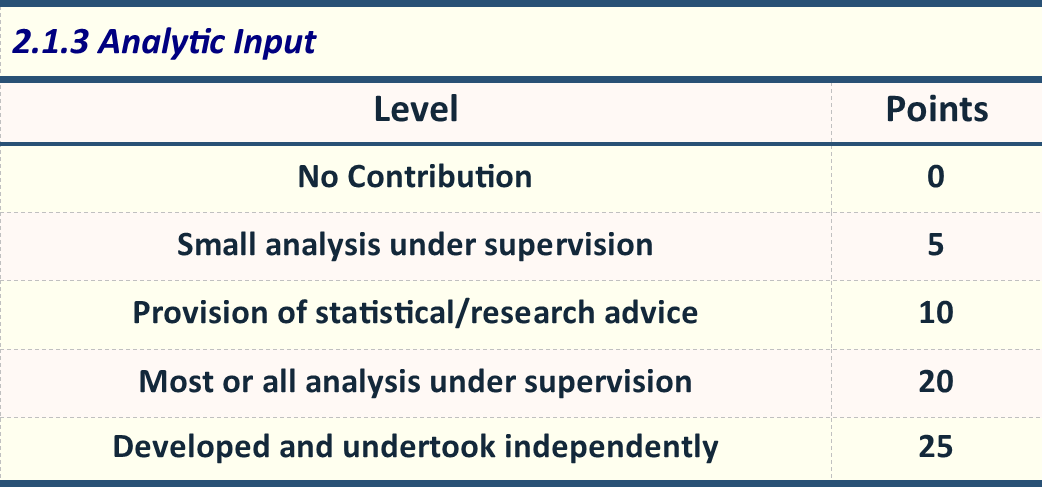
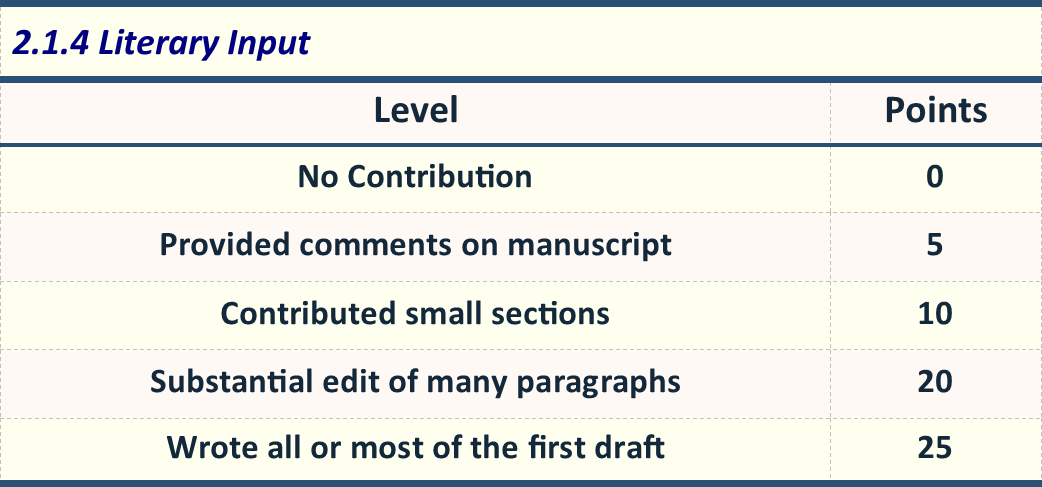
Stage 2.2: Scoring — out of 90
Retain: 25-90 points
Reclassify author: Below 25 points
Remove paper: Authorship alone does not justify removal, only factual inaccuracy and integrity concerns, as per UKRIO and COPE guidelines below.
“If there is no reason to doubt the validity of the findings or the reliability of the data, it is not appropriate to retract a publication solely on the grounds of an authorship dispute.”
Good practice in research: Guidance for researchers on retractions in academic journals 2010 (UKRIO and COPE, 2010)
Stage 2.3: Outcomes
In line with BTO guidance, any contributor scoring 25 points or more out of a possible 90 should normally expect to be included as an author. This is consistent with the principle that authorship requires substantial contribution across multiple ICMJE criteria.
Where a contributor’s scores below 25 points, the panel will additionally assess whether their contribution met all four ICMJE criteria.
Reclassification is confirmed only where the contributor fails one or more of the following criteria:
ICMJE Criteria
1. Substantial Contribution to conception, design, data, analysis or interpretation.
2. Draft or critically revising
3. Final Approval of the version published
4. Accountability - agree to be responsible for the accuracy/integrity of the work.
Stage 3: Final Action
Alongside applying both quantitative methods for this review, the panel will take into consideration evidence, observations, and representations collected over the call for evidence period, until 31st May 2026, submitted to Review Panel via email: ECR.2026@trafalgaranalytics.co.uk. (Readers and authors alike, are encouraged to submit constructive thoughts.)
ECR Panel Chair
G. Patriot, Associate - Data Science. (Full Review Panel membership to be confirmed.)
Trafalgar Analytics, April 2026
Download the full ECR Guidelines above. Each publication under review should be accompanied by its own individual scoring sheet.
At Trafalgar Analytics, we are building the leading Data Analytics and Research Centre on the British Right.
Our expertise sits at the intersection of data science, economics, and political science.
Founded in May 2025 by engineers, finance and consulting professionals, we solve problems from first principles and inform public debate, ahead of the socio-economic and political realignment of 2029. We provide decision makers with data insights, strategy, and operational support.
As we approach one year of Trafalgar, we would like to thank all our readers, subscribers, and supporters; without you, our work would not be possible.