Data & Decision Insights #5
State of the Economy, Monetary Policy, New Year's Resolutions for Reform, Jury Reform, and the National Security Strategy

Welcome to the fifth edition of Trafalgar Analytics’ Data & Decision Insights.
We hope you have had a restful and merry Christmas, and a great start to the new year. Over the last three months, we have been hard at work, nevertheless we are due our first Insights Briefing of 2026!
Our research associates and independent contributors will be reflecting on the topical issues of the past year and addressing some of the most pressing political and economic issues that Britain will face over 2026. We will be breaking down how our decision makers think, as well as highlighting success stories and events to look forward to.
Agenda for this Insights Briefing
1. State of the British Economy 2026, by the Economics & Growth Team. (Free)
2. Rethinking Monetary Policy: an overview, by Greggs Patriot - Associate. (Free)
3. New Year’s Resolutions for Reform, by Bukes - Associate. (Free)
4. Jury Reform Hysteria: Four counter-arguments, by Eulipotyphla - Associate. (Free)
5. Military purges & more: let’s visit China, by the International Affairs Team. (Free)
6. What does the new American National Security Strategy mean for Britain and Europe? by the International Affairs Team. (Paid)
7. Assessing Kruger’s civil service reforms, by the Elections & Polling Team. (Paid)
8. What does 2026 have in store? from the Trafalgar Team. (Paid)
If you enjoy this Insight, do follow Trafalgar Analytics on Twitter and Substack - like, comment, or share with friends and family. Happy New Year!
Tribute: Peter Whittle (1961-2025)
We pay tribute to the late Peter Whittle, who passed away in November 2025. Many readers will remember him as a decent, hardworking and thoughtful London Assemblyman (2016-21), as well as Founder of the New Culture Forum, and Convenor of the cross-party forum The Trafalgar Group, our namesake. Across the Right-of-centre, Peter meant so much to so many. We will never forget the huge amount of time that he had for us, at Trafalgar Analytics. We will remember his kindness, character and for building the NCF into a lasting institution - an integral part of Britain’s political fabric.
If we can embody just a fraction of his generosity, collegiate and convivial spirit, politics and Britain will be a better place. Godspeed, Peter.

Note of thanks: Quicksort
In early December, one of our pseudonymous team members, Quicksort, parted ways with us to pursue new adventures. We wish him every success in his next chapter. We will always hold Quicksort in the highest esteem for his boundless energy and hard work, which was near-unrivalled. Upwards and onwards!
1. State of the British Economy 2026
In a UK context, forecasting what will occur in 2026 has largely focused on the following assumptions:
· UK GDP growth remaining soft;
· Inflation continuing to fall back to target;
· Keir Starmer facing a leadership challenge.
Whilst the above deserve discussion, they somewhat ignore the economic issues that are bubbling beneath the surface in Britain that warrant more attention, which we will be writing more about this year:
1.1 The ‘abacus-ification’ of policy making
Successive governments (both Conservative and Labour) have been suffocated by the OBR. This body which was conceived by George Osbourne to instil fiscal discipline into governments with their forecasts accompanying Budgets is a clear hindrance to any meaningful change to the fiscal norms in the UK. When constructing policies, politicians now do this by considering whether it will trigger alarm bells from the bean counters at the OBR rather than building policies from their principles. The forecasts lack depth, often ignoring second-order / dynamic impacts of policies. The OBR is not needed. Markets encourage fiscal discipline where it is warranted.
In October 2025, the ONS (which the OBR relies on to make its forecasts) had to revise its estimates for government borrowing by £2 billion, after being informed of inaccuracies in VAT receipts; whilst in August, the monthly retail sales data had to be postponed; and before that, in April, the ONS managed to overestimate the inflation figures. This is no way to run an advanced economy facing huge fiscal pressures.
1.2 The UK’s debt structure
Developed nations as a whole are increasingly facing a greater term premium (bond investors requiring greater compensation to hold longer-term bonds), on the back of concerns over aging populations and the associated healthcare costs / fall in the working population. Beyond the more general issues facing developed market economies, the UK faces a number of more structural elements, which have not been spoke about as much:
1.2.1 Inflation-linked debt
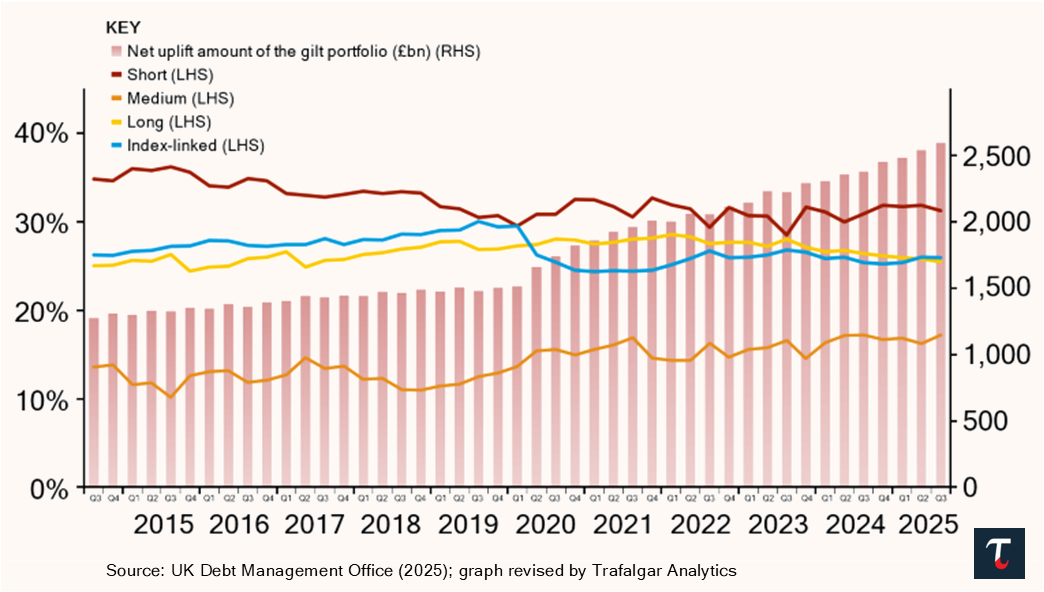
The UK has a significant proportion of inflation-linked debt compared to most developed nations, making it vulnerable to bouts of inflation. There needs to be dynamic mechanisms in place, so that when rates are low the UK offloads some of its inflation-linked debt (i.e. offer a premium to investors to covert to a fixed-rate, if rates go below a certain level). To highlight this issue, the UK’s index-linked gilts hovers at 25% of its total gilts and treasury bill portfolio, whereas this figure is closer to 10% in most countries, see Exhibit 1. This makes UK debt more exposed to inflation as inflation risk is faced by the government rather than the investor.
1.2.2 ‘Moron’ premium
When we look at the UK gilt yields compared to their European counterparts, the UK continues to have elevated yields. This has little justification on a fundamentals level (debt to GDP ratio, etc), but rather a legacy of the Truss mini-budget. France has debt with a c.4.2% yield for 20 year bonds as at the end of 2025, in spite of its current fragile political situation. German bunds are at c.3.4%, whereas the UK 20-year gilt yield is at c.5.1%. Essentially, investors have less faith in the fiscal sustainability of UK budgets, so the government is having to pay more to service its debts.
1.2.3 Foreign ownership
With Defined Benefit (“DB”) pension schemes maturing, the make-up of gilt investors is changing with more foreign ownership. At present, UK pension plans buy gilts largely for hedging (to allow them to hedge interest rate and inflation risks of their liabilities), so will buy them regardless of the yield offered. With more foreign investors, they are demanding higher yields for the asset class to be attractive to them. As such, with foreign ownership comes greater volatility in yields (i.e. they are more sensitive to changes in the governments fiscal direction).
1.3 Deteriorating labour market dynamics
Persistently high economic inactivity is an increasing concern, and one which is impacting both younger generations and certain ethnic groups to a greater extent (though for different reasons). There is a strain on the UK’s fiscal position as a result, and a strain which is a result of deliberate choices by the government to not challenge this activity. Beyond this, with the rise of the gig economy and other service sector businesses, we are also seeing a significant increase in individuals who are not properly taxed.
Looking at one example, Deliveroo doubled the number of riders from 25,000 (2020) to 50,000 (2021) over the pandemic; today, it has reached over 100,000 active riders (2024). Pegasus estimates there are 320,000 drivers in the overall delivery sector (including food, parcels, and goods). Eventually, we will have to grapple with the full social and economic consequences of having so many people joining the gig economy.
1.4 Tax system complexity
Whilst there is undoubtedly an increasing fiscal strain on productive individuals in the UK, the way this is taxed is increasingly complex. Rather than simply increasing income tax, the current Labour government has decided to impose all manner of different taxes on items from gambling, dividends, savings to capital gains adjustments. Such a system is needlessly complex, it would be more honest and cost effective to impose changes to income tax rather than tinkering with a raft of other taxes.
Under a more transparent system where this is done, voters would gain a clearer understanding of how much they actually pay in taxes at an aggregate level, which will see government more accountable for its spending. It goes without saying simplification of the tax system has not been a Conservative or Labour priority (beyond their rhetoric). Whether a future government will be able to truly tackle the issues facing taxation is uncertain.
By the Economics and Growth Team, Trafalgar Analytics
2. Rethinking Monetary Policy: An Overview
It has become something of a cliché for British political commentators to dismiss the doctrine of separation of powers as a crude American import. They boast that Parliamentary sovereignty means ‘you can just do things’.
Yet if any domain should test our commitment to democratic control, it is money itself: who creates it, on what terms, and in whose interests? When we consider the quantity of money in existence, and who has the authority to increase or decrease it (if indeed it should be changed at all), Parliament has in practice ceded control. In fact, Parliamentary sovereignty over this area would be seen by some as an aberration, akin to a form of tyranny, at the very least simplistic, and ignorant of how the economy really works.
Fears of tyranny have often expressed themselves through ideas and policies designed to restrain government power: the gold standard, central bank independence, even an imagined world of cryptocurrencies. Each, in its own way, promises to be an external constraint on political authority. Yet this promise is illusory. Ultimately, the only force capable of constraining government power is the political process itself. No technological or institutional workaround can abolish this reality. Even now under operational independence, if it wanted to, HM Treasury could instruct the Bank of England to expand its Ways and Means facility by any amount. In fact, under a gold standard, the government could decide to come off that standard at any time. This country did exactly that in 1797 when a French invasion of Fishguard caused widespread panic. The restriction period, as it was known, lasted until 1821.
The actual problem is that money creation is not political enough. It is too obscure, decentralised and bureaucratic. Britain’s money should not be diluted or undermined by forces beyond democratic control; whether that be a Russian goldmine, a Chinese data centre running Bitcoin, or as is currently the case, certain financial transactions in the private sector.
Concerns about the quantity of money may also be dismissed as monetarism, a defunct school of thought prominent in the earlier era of Margaret Thatcher’s government. At the time, the Bank of England failed to control the quantity of money as intended because the policy tools used were not appropriate for both defining and controlling the money supply, especially in an era of rapid financial innovation. The Bank now prefers to use the interest rate to control price inflation, via the monetary policy transmission mechanism. This is symptomatic of a view that money is something fuzzy, that different assets have varying levels of moneyness, and should therefore fluctuate with trade and the needs of the wider economy.
There was a movement in Britain that focussed on fundamental monetary reform called Positive Money, founded by Ben Dyson. They did excellent work highlighting, and bringing to the attention of a wider audience, the process of money creation and destruction that commercial banks engage in when they issue new loans and receive repayment, as well as the Bank of England’s role in maintaining it. Dyson left Positive Money in 2016, and the organisation has since gradually deemphasised any ambition of achieving sovereign money, instead lobbying for more generic left wing social and environmental policies related to finance.
Furthermore, although Positive Money emphasised the lack of democratic oversight regarding money creation and the potential ramifications this has for economic inequality and financial instability, they failed to articulate the extent to which the state is simply being ripped off by the banking system as a whole. Banks have effectively usurped the government’s sovereign right to create money, but this is just the status quo. It should be noted, this right has never been properly asserted. Historically, it was undermined by the policy of having an open mint, allowing merchants to coin any amount of gold or silver they wanted to at the mint price. This state of affairs is also obscured by the competitiveness within the banking system. Broadly speaking, people in government and finance do not see anything inherently wrong with it. Yet this is the primary reason why monetary policy deserves far more scrutiny.
Thankfully Richard Tice, Deputy Leader of Reform UK, has ventured where others have not, by persistently speaking out against the Bank of England’s policy of paying interest on reserves. Though some would say naive, Tice’s observation that essentially we are just giving banks free money for no good reason, is extremely refreshing. Whilst he has received sympathetic coverage from Sky News’s Ed Conway, who believes the Bank’s “radical monetary experiments” should be more prominent in political debates, there has undoubtedly been a significant amount of criticism, including from Andrew Bailey, the current Governor of the Bank.
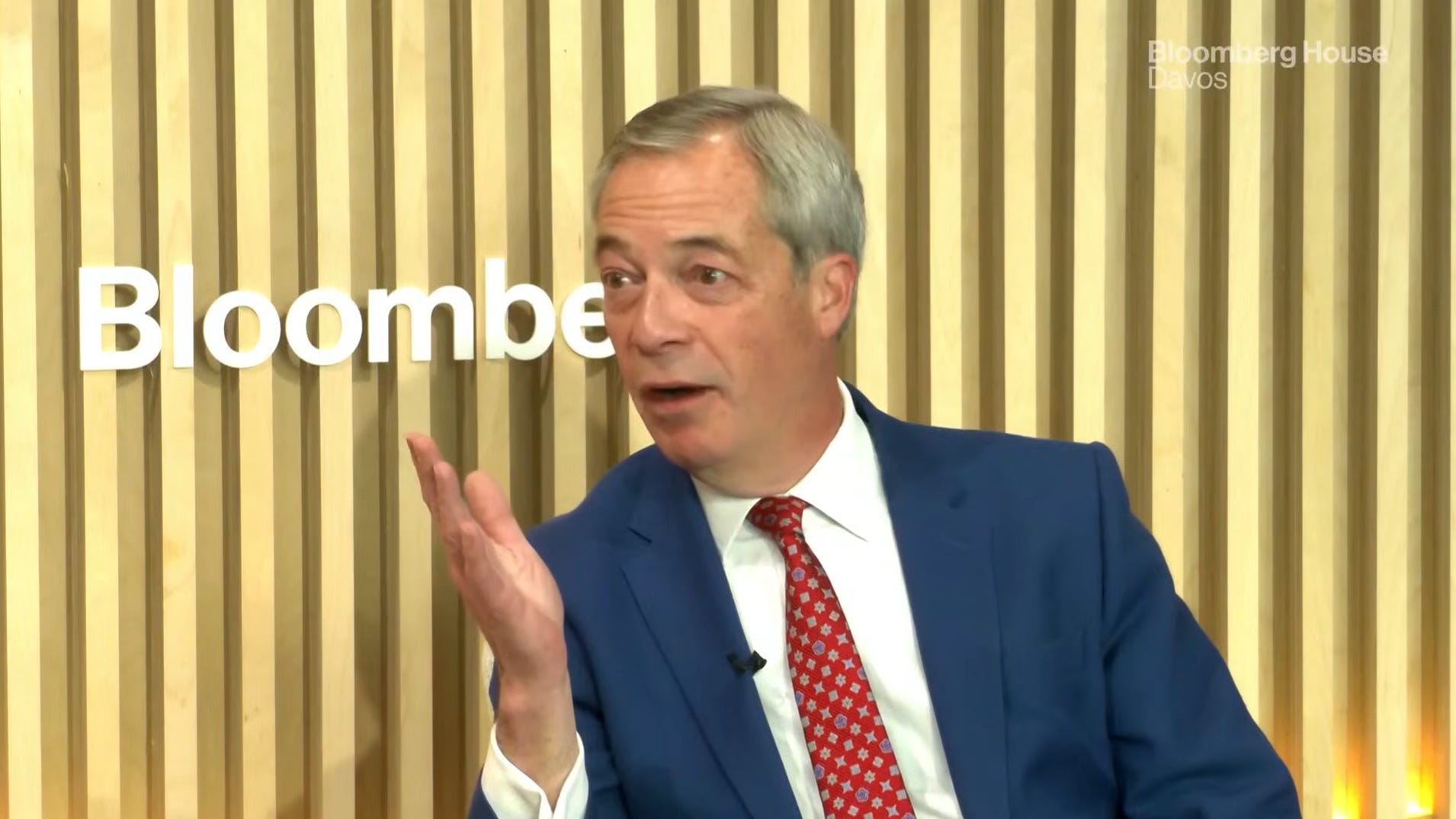
The arguments against not paying interest generally fall into three categories. The first is to simply assert it would amount to a “tax on banks”. This is dishonest. Interest payments on reserves are by any reasonable definition a subsidy and removing a subsidy is not a tax. This point was forcefully made by Nigel Farage in a recent Bloomberg interview at Davos. The two other arguments, that all costs will be passed on to the consumer in the form of less competitive borrowing and saving rates, and that it is essential for monetary policy, are more nuanced, and will need to be addressed in greater detail, with fresh arguments and data.
However, this cannot be done in isolation. A broader national debate must take place regarding Britain’s overall approach to monetary policy and its consequences for state capacity because, importantly, Tice has brought to focus just one of four major areas where bold changes could expand the government’s ability to cut taxes or increase spending. In broad terms, these levers are:
(1) reducing interest on reserves;
(2) increasing structural demand for gilts;
(3) capturing a larger share of the seigniorage from monetary dilution; and,
(4) reshaping fractional‑reserve banking, so that more of its benefits accrue to the public.
The challenge is to unlock this capacity whilst ensuring essential banking services are still universally accessible, and there is sufficient dynamism within the broader financial sector. However, there could also be wider benefits to reforms that lead to interest rates being determined more by market forces and less by a central authority.
On conservative assumptions, the combined fiscal space unlocked could plausibly approach £100 billion a year. Outlining the policy choices that would need to be made, will require much more extensive work. At Trafalgar Analytics, we seek to light the way for more informed public discourse over monetary policy, by setting out the arguments from first principles, and providing the relevant data and modelling.
We should be wary of existing “experts” in the field, perhaps treated as if they were high priests of an obscure foreign religion: highly knowledgeable potential sources of wisdom, but ultimately clouded by dogma and a questionable record. Monetary policy (although rich in history) has evolved and been implemented haphazardly under a set of conventions that obscure the truth. What has emerged over the centuries is a kind of intellectual iron prison.
Perhaps the origins of this prison lie in the impassioned 19th century debates between the Banking School and Currency School. Both sides were passionate, but wrong, and this led to the messy compromise of the Bank Charter Act 1844. From then on, a few have done their best to explain and work within the system they inherited, most notably Walter Bagehot, who wrote Lombard Street in 1873, and more recently, Mervyn King (Bank of England Governor during the financial crisis), who wrote The End of Alchemy in 2016.
Their solutions are that central banks should act either as a ‘lender of last resort’ or ‘pawnbroker for all seasons’ respectively, however these policies do not fundamentally change the roles of banks and the state. There are schools of thought that are more radical (such as Austrian economics, modern monetary theory, free banking, and Bitcoin maximalism), but have tended to become ideological ghettos, especially as they are generally not attached to any coherent political program.
Clearly, to have any realistic chance of influencing policy, this iron prison must be taken very seriously. But Britain can escape.
By Greggs Patriot, Associate (Economics & Growth), Trafalgar Analytics
3. New Years Resolutions for Reform UK
Reform UK had an undeniably successful 2025. In 2024, their ascent from a UKIP-sized carve out at the 2024 General Election (14.3%) to matching the Conservative Party in the polls (23%) by the end of that year was commendable enough. In the following year, Reform UK topped every poll since February, and has managed to become the largest party in Britain by membership. One could argue that neither of these successes were borne out of anything particularly bold or improved in the party’s strategy, but in their almost-effortless exploitation of Labour’s currently-fractured state. It is reasonable to believe that Reform’s vote share could soon cross the 40% mark. Not least, because the 2017 and 2019 General Elections delivered 42.4% and 43.6% of the vote share respectively to the Conservative Party.
However, since May 2025, Reform has plateaued at around 30%. Going forwards, its primary goals are:
Goal (1) – Continue to build legitimacy for Reform’s new identity as the pre-eminent party of opposition.
Goal (2) – Continue to expand Reform UK’s electoral coalition.
The degree to which both are achieved will determine the party’s chances at being able to form a majority government in the next General Election. It is important to critically assess Reform UK’s strengths and weaknesses as a party heading into the May elections next year, and what they might have to prepare for in the months and years ahead. Reform has many advantages going for it, but these could be lost without savvy adaptation to changes in the political scene. Complacency and inaction threaten to freeze or even reduce Reform’s popular support.
3.1 Inheriting Toryism
How Reform UK handles the dismemberment of the Conservative Party is like a chef preparing a Fugu fish for consumption. If they are not careful, they could poison Reform UK’s brand forever – even before they have been given the chance to govern from Whitehall.
There is a real risk that Reform could suffer under the rapidity of its own success. Having capitalised so efficiently on the Conservative Party’s worst ever election defeat, Reform has taken up the mantle as the principal right wing party of the country. However, this has come without any substantial changes having occurred to the political infrastructure which previously served the Conservatives. That means that it has not had the time to develop its own independent, or at least distinct, patronage circuit solely dedicated to the Reform project.
Already established journalists and think tank operators are crowding out space which Reform UK should be organically opening up. Many of these characters actually hold little animosity to the Conservative Party, but are nevertheless abandoning it out of political opportunism or convenience.
This phenomenon has also had an impact on the makeup of Reform’s local political scene, expressing itself in its branches and councillors. The overnight inheritance of the Conservative Party’s membership has meant that many Reform UK branches at their inception were operated by people whose views are ideologically indistinguishable from old school Toryism. Though it was necessary and inevitable that Reform would gain the support of the broad right-of-centre, the speed at which they did it could mean that Reform are more bound by the need to appeal to older visions of a right-wing party than they might want to be. That being said, Reform needed to establish their party infrastructure as efficiently as possible to meet their astronomical popular support, and they did; for that, the party is deserving of praise.
But given this backdrop, we have to ask how distinct is a Reform administration from a Conservative administration? As it stands, the answer depends upon which part of government we are referring to – but, it should not. It currently does, because the hundreds of elected Reform UK councillors have ‘lower’ responsibilities, less scrutiny and a degree of autonomy, which means there is a tendency to fall back on Conservative principles rather than try to work towards the national party’s broad vision.
To take one example, Reform saw success this year by positioning themselves as a right wing party that was not in favour of austerity. Whether good policy or not, Reform UK rejected the scrapping of the Winter Fuel Allowance, and came out in favour of removing the Two Child benefit cap.
Do local party branches, freshly-formed Reform UK councils, and mayoralties have the self-awareness to know when to deviate from their orthodox conservative instincts, in favour of winning positions? Or perhaps a better question might be: is Reform UK’s national party infrastructure effective enough to disseminate such positions?
These questions in turn open up another part of the discussion, which is the extent to which Reform should accept former-Conservative figures in order to achieve Goal (1). Maximising its potential towards legitimising itself as the successor party to the Conservatives could inadvertently diminish their ability to achieve Goal (2) if voters end up viewing Reform as broadly similar to the party that they (rightly) despise and rejected in 2024.
Some part of the Labour Party campaign machine was still competent enough to see some of these ongoing contradictions and so repeated the point often in the lead up to the 2025 May council elections. Irrespective of how badly Labour did in those elections, it is a line which will come up more frequently, as long as Reform UK continues to absorb former Conservative faces.
This is something Zia Yusuf clearly understands, posting a lengthy justification as to why approving of Danny Kruger’s defection was the right decision. Similarly, and most recently, the defections of Nadhim Zahawi and Robert Jenrick have been followed by a “deadline day for defectors” of May 7th and Nigel Farage justifying these defections in the Telegraph.
The quality of Reform UK’s Defection Filtration System (DFS) has determined, and will continue to determine, the texture of Reform UK in the minds of many voters. Arguments could have been made against the accession of Andrea Jenkyns into the party, given that she chose to run as a Conservative in the 2024 General Election unlike Lee Anderson, among other reasons. Likewise, arguments could have been made against allowing the defection of Jake Berry, Jonathan Gullis, Lord Malcolm Offord, or (particularly) the defection of Nadine Dorries and the platforming of her at ‘RefCon 2’. Equally, providing Ben Bradley (another former Conservative MP) a position involved in Reform’s local governments sets the tone before the party has had the chance to present itself as a distinct new force in British politics.
In short, what Reform gains from demoralising the Conservative Party, could be lost in unquantifiable future losses, as the party burdens itself with unnecessary baggage. One of Reform’s unique appeals is that it is a fresh third party without a history of complicity in Britain’s ruination. Thus, inviting big name Conservatives to the fold could be harming its brand in ways that are not necessarily seen in the current polling.
As a supplementary but important observation, too many ex-Conservatives will end up self-restricting Reform. Defectors raising criticisms of Reform UK privately, or pushing for a certain vision of the party publicly, could end up narrowing the electoral coalition that the party can assemble. The starkest example was Nadine Dorries suggesting on live television that Boris Johnson, responsible for his now-eponymous Boriswave, would be welcome in Reform. This was immediately followed by Zia Yusuf, Aaron Banks, and Tim Montgomerie all coming out to run damage control. This phenomenon could get worse and diminish Reform’s ability to campaign effectively on its distinct platform the more defectors it takes on. Defectors are, by the nature of their actions, disloyal; there is no reason to believe they will be more loyal to Reform UK than they had been the Conservative Party or any other party they might be coming from.
The defections that have happened are as they are, but debates over how forgiving Reform UK should be for any future defections should be had with these considerations in mind. Reform UK seems to be effectively walking the tightrope by their justifications of each defector they have taken on so far. The period between Reform’s deadline day for defectors and the next general election is long enough for Reform to be able to cultivate its own identity further.
3.2 The 2026 May Elections
At Britain’s 2026 local elections in May, all 32 of London’s borough councils, 32 other metropolitan boroughs, 18 unitary authorities and 6 mayoralties across England will see elections. Some are set for elections for 1/3 of their seats, others all wards are up for election. Whilst last year’s local elections predominantly occurred in Conservative-held areas of England, this year’s will occur in mostly Labour-held areas. 66% of London’s borough councils, 76% of other metropolitan boroughs, 44% of unitary authorities and 50% of mayoralties up for election are Labour-controlled.
These elections are held at the same time as devolved government elections take place in Wales’ Sennedd and Scotland’s parliament. Looking at the most recent polling average, Reform UK could either become the party of opposition in Wales or take control of the devolved government. For Scotland, the question is whether Reform UK can become the second-largest party or not. Currently, Reform UK and Labour are about equal by polling average, around 15% behind the Scottish National Party. Reform UK has seen steady growth in Scotland and has not plateaued in the same way that they have nationally, which could suggest Reform may find achieving opposition party status easier than it seems as of now.
To campaign and win in post-industrial, “red wall” type areas in Wales and Scotland, Reform UK might have to lean further into more economically populist positions. Reform UK has already shown an appetite for this, with Lee Anderson during the Caerphilly by-election saying that Reform UK would “reindustrialise” such areas were they to get into government. This can be seen as being consistent with Nigel Farage pushing conciliatory rhetoric on union activity, and the party supporting nationalisation of British Steel. What policy vision there is that would back up such positions remains to be seen, possibly being further developed before May in the lead up to those elections with sights on devolved administration. For Reform UK to manoeuvre in this way, they may jeopardise Goal (1) in the short term, possibly leading to some internal division and movements in the polls between Reform UK and the Conservative Party.
Reform UK will come under more scrutiny as they accrue more government power. Devolved administrations are restricted much more by Westminster than people understand, and having more Reform-coloured rosettes on the politicians “in charge” could breed animosity for Reform UK as a party seen to be not doing enough.
Taking control of the Welsh government should be seen in that context. An administration there might overshadow their vision for the country as a whole years later in the run up to a general election. Even if it is successful, it might still restrict policy discussions going forward. Welsh Reform UK politicians could be as regional and nationalistic (in the four nations sense) as Plaid Cymru, by the nature of the party still attracting patriotic, communitarian minded people as candidates. Choosing the right candidates, ones who can communicate effectively and talk often of the areas of government they can’t change without Reform UK in Whitehall, will be critical. This will be an important consideration, as it chooses its next leader of Reform UK Wales and builds its team towards the Senedd elections.
Regardless of strategic thinking, tactically it is most optimal for Reform to win as much as possible – and that means prioritising Wales, secondarily focusing on Scotland and picking up what they can in England. Winning shows momentum and ingrains a sense of inevitability for the next general election’s outcome.
3.3 The Labour Party
Keir Starmer is a uniquely absent Prime Minister, in that he is unable to articulate a unique vision for his government (some might say he is temperamentally conservative). There cannot be a vision distinct from his own government, because to have one would be to diverge from the establishment orthodoxy, which he fundamentally believes to be ideologically correct. Whether it is the 29th year of New Labour or the 47th year of Thatcherism is a matter for debate, but what is not up for debate is that the British people are deeply dissatisfied with things as they are. Keir Starmer’s Labour government suffers from the contradictions within their 2024 General Election campaign. It both promised change after 14 years of successive Conservative governments yet also promised by manifesto commitments to govern like the Conservative party (particularly on the economy). Other oscillations and incongruencies seem to be apparent too, with Keir Starmer both giving big speeches admonishing mass-immigration in principle whilst also labelling Reform UK and Nigel Farage as racist for the same beliefs. For this, and many other reasons, the Labour party has created a set of conditions that has meant the fragmentation of their electoral coalition.

The Green Party under Zack Polanski now almost ties Labour by polling average, an astonishing change from their 10 point gap when he was first elected party leader. Many on the left will see it as a sign that Zack Polanski’s brand of “woke” social liberalism is more popular than Starmer’s perpetual attempt to pander to ex-Labour Reform voters, and they might be partially correct. In a polarised political era, one in which “the centre” hasn’t disappeared, but has changed and widened, securing core voters first is more important for the Labour party than extending their electoral coalition. Note however, that Reform is in the reverse position, with a solid lock on their core voters and able from a position of strength to appeal to less right-wing voters in order to extend their electoral coalition.
Zack Polanski’s primary appeal however is his alternative, anti-establishment proposals for the economy that offer something positive for many people in the country. When 74% of Britons believe that the economy will worsen over the next 12 months, having an economic platform that is distinct from all other main parties is a huge plus. If Labour wanted to challenge Reform UK effectively, they would have to tack left and reassemble their coalition first before they could meet Reform UK in the contemporary centre ground, of which Blairism is not home to. The Conservative party is currently trying (and failing) to do the right-wing equivalent of this.
It would be unwise for any party to entirely dismiss what Polanski is doing, with repeated references to breast enlargement hypnosis and the Green Party’s drug liberalisation policy. If Reform UK wants to make serious overtures to graduates, students and teenagers, it will have to make policy overtures with clear and direct benefits for those groups, irrespective of the potential detriments to other groups due to those policies. Right now, in spite of all his shortcomings, it is Zack Polanski and the Green Party doing that most effectively – and that is saying something.
Many on the right like to cry foul at every decision Reform UK makes, quick to feel betrayed and out control. But the party under the leadership of Nigel Farage, Zia Yusuf, and Richard Tice have built a political project deserving of trust. By their actions, they are clearly aware of the nuances of the coalition they have assembled and what they will need to do to form the next government. The more trust the right puts into Reform UK, the easier it will be for them to extend their coalition with overtures to demographics outside their base. How much Reform UK moves towards promoting itself as a successor to the Conservative party rather than a conqueror, or indeed the inverse, will be determined by the needs of the moment as the mood of the country changes. How effectively they do this will determine their success in achieving Goal (1) and Goal (2).
By Bukes, Associate (Strategy), Trafalgar Analytics
4. Jury Reform Hysteria: Four counter-arguments
In December 2025, full details of jury trial reforms (proposed by David Lammy, Labour’s Justice Secretary) started to emerge, to much consternation - on both sides of the political aisle. However, here we surface a heterodox view over these reforms, and why perhaps the new Right should not stake any further political capital on attacking these reforms.
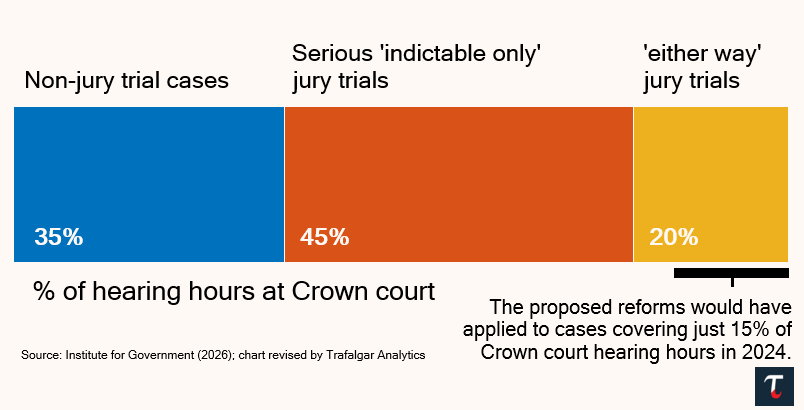
So, what is being proposed? The headline is that jury trials will be restricted to primarily to ‘indictable-only’ offences (such as murder, rape, manslaughter) and certain ‘either-way’ offences (including theft, burglary, and actual bodily harm) that meet a public interest test or carry a likely sentence of over three years. Proposals also allow magistrates courts to handle more cases with sentences up to 18 months (potentially up to two years), and to create ‘swift courts’ in the Crown court where a single judge may preside over the less serious ‘either-way’ cases.
The political reaction by Reform, Tory, and Labour backbench MPs was inevitably pandemonium. Was it true that the Labour Government was going to end this great tradition of jury trials - stemming back to the Magna Carta of 1215? “No free man is to be arrested, or imprisoned, or disseised, or outlawed, or exiled, or in any other way ruined, nor will we go against him or send against him, except by the lawful judgment of his peers or by the law of the land.”
There are four principal arguments as to why the political fallout has been borderline hysterical, and why discerning actors on the new Right may find it more political expedient not to fight these proposals any further:
4.1 “Or by the law of the Land”
Most people commenting over their rights guaranteed under Clause 39, have omitted to note that the Magna Carta did not, in fact, guarantee a jury trial of one’s “peers” for every case. The very end of the clause “or by the law of the Land”, left room for non-jury processes from the very beginning. Unsurprisingly, our criminal justice system has reflected this for many hundreds of years.
In 2025, over 90% of criminal cases are dealt entirely by our magistrates courts, seen by a panel of three magistrates or a single judge. The remaining 10% of cases go to Crown court; only 1-3% of cases go to jury trial; however, jury trials do take up 65% of hearing hours at Crown court, see Exhibit 2. What is noteworthy is how much political capital is being spent on such modest proposals. At best, these reforms will save a fraction of time for just 15% of the Crown courts’ caseload, itself a small portion of the country’s overall caseload.
4.2 Who counted as “free men”?
The freemen covered by the Magna Carta referred to men who were lords, knights, yeomen who held land freely, burgesses with borough freedoms, and certain merchants. Between the Doomsday Book and 1215, this was around 12-20% of Britain. Rightly or wrongly, this wealthy section of the population was seen as the elite human capital of the time.
Invariably, both juries and magistrates were selected following these principles for 750 years after the Magna Carta: male homeowners above a certain wealth, which amounted to 5 to 10% of the population. This criteria was expanded in 1919, when some women homeowners were eligible. But, until 1972, juries were still very restricted, after which property ownership and occupation rules were removed, and then it was linked to the electoral roll.
It may be easy to romanticise modern jury trials, but until fifty years ago, jury service was historically meritocratic, restricted to the most wealthy and educated ⁓10% of Britain.
4.3 ‘Democratic’ juries in a multicultural society
Today, Britain is a multicultural society, as diverse as Singapore, and in our cities, more so. At around the same time that Britain expanded the franchise for juries and magistrates, Lee Kwan Yew abolished jury trials in Singapore in 1969. He cited “superstition, ignorance, biases, [racial and religious] prejudice” as reasons why juries could not work in multi-racial and multi-cultural societies. Inevitably to limit the worse excesses of this in Britain, jury selection (where lawyers on both sides questioned and selected jurors) was abolished in 1977. Some lawyers defending ethnic minorities objected to white jurors to maximise chances of an acquittal.
However, as today’s juries are representative of the local communities that they are drawn from, the ability for lawyers to partake in individual jury selection has not ended this phenomena. Modern juries hold up today’s two tier justice. Whilst Lucy Connelly was jailed for a deleted tweet, juries in London have acquitted Labour Cllr Ricky Jones calling for the throats of “fascists” to be “cut”, as well as clearing the sledgehammer-wielding group Palestine Action of burglary, despite video footage fracturing a policewoman’s spine.
Unsurprisingly, defending jury trials is now seen as a left-wing issue for many Labour MPs, including by former Corbyn frontbencher Karl Turner, who has threatened to call a by-election on his own seat if the Government forces through these plans. It is on those terms that political actors on the new Right should rethink its opposition to these proposals.
Juries are nameless, unlike judges. Remember 2016, when the Daily Mail targeted three High Court judges who tried to obstruct Brexit and named the public servants on their front page “enemies of the people”. Juries can never be held accountable in such a public way, whereas judges can be. If accountability is what the Right wishes to optimise, perhaps fewer jury trials is not so bad.
4.4 Reimagining the criminal justice system
Building on an earlier Trafalgar paper on Law and Power in Britain, fixing the criminal justice system in Britain is no longer about the maxim “justice must not only be done, but must also be seen to be done”, but actually that “justice must be seen to be done without delay”. On these terms, even if there may be some valid concerns over further erosion of jury trials (though nowhere as significant as the changes of the past fifty years), we must recognise that Lammy’s proposals seek in part to clear the 80,000-case backlog facing Crown courts at moment.
This is actually an important point for the Right too. If a new radical Reform government is indeed set to come to power in 2029, on every aspect of the criminal justice system, it must be streamlining processes. From police response times, time-to-trial, backlog volume, and speed of deportations, a truly radical government must be able to tackle all these fronts.
In doing so, many sacred cows will be slayed, upsetting many stakeholders. The only party that is truly a law and order party, is one that takes a wholesale approach to prioritising speed and restoring public trust in our system’s effectiveness. In this regard, Reform should be on the side that recognises the basic truth: the existing system is too slow, broken, and needs streamlining at every level.
By Eulipotyphla, Associate, Trafalgar Analytics
5. Military purges & more: let’s visit China
In the backdrop of Keir Starmer’s visit to China in January, there has much debate over the purpose of his ‘reset’ visit, the first in eight years. From a cursory view, it appears that this visit took place with the proviso that Britain would approve the new Chinese embassy in London, which has been widely criticised as too large and would quickly become a hub for Chinese intelligence services.
In return, Britain seems to have secured a reduction in tariffs on its whisky exports, a few export deals (worth £2.2 billion, a relatively paltry sum), 30-day visa free travel for British citizens entering China, and the lifting of sanctions on sitting UK parliamentarians. But with no free trade reached, many analysts have viewed this as a damp squib.
China watching has long been a difficult challenge for British and Western observers, largely because of the language barrier and the controlled media environment. Invariably, the commentary reaches tealeaf-reading territory. To the extent, some have suggest that China may have snubbed Britain, as Keir Starmer was just given a tour of the Forbidden City with a regular tour guide, whereas Xi Jinping had closed the palace and personally joined on Donald Trump’s last visit. Whether this interpretation is accurate or not, it is not particularly far-fetched compared with our usual efforts at understanding the inner workings of the Chinese state.
Never the less, it is important for us to try build a better picture on how China operates. In Trafalgar’s last Data & Decision Insight (#4), we outlined the worldview of Wang Huning, who has been the Chinese Communist Party’s principal policy chief over the past twenty-five years. In this Insight (#5), we shed some light over the most recent and significant purge in the history of the People’s Liberation Army (the CCP’s armed wing, and the world’s largest army).
British media have mostly not commented on the 2023-2026 purges in the PLA, even though they seem to have only just paused a few days before Starmer’s visit. Whilst this purge may not appear to directly affect Britain, its reverberations will have many real consequences for the world.
The PLA is governed by a seven-member Central Military Commission, appointed at the last (20th) Party Congress in 2022. Since then, the Defense Minister (Li Shangfu) was removed from the CMC in late 2023 on corruption charges. After that, the Political Director (Miao Hua) was removed over “violating discipline” in the fall of 2024, implying a corruption-related allegation. A year later, one of the CMC’s Vice Chairmen (He Weidong) was suspend in October 2025 over “crimes involving exceptionally large sums of money”.
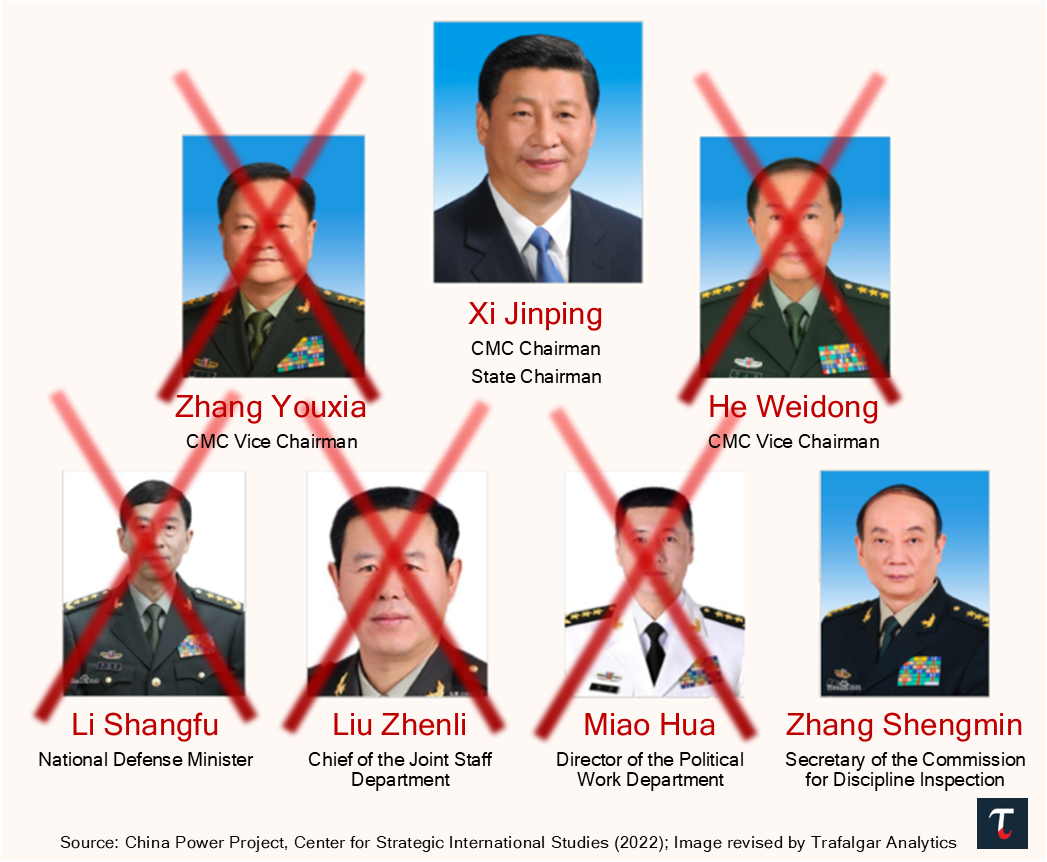
Last week (24th January 2026), it was announced that Zhang Youxia (the first-ranked CMC Vice Chairman) and Liu Zhenli (Chief of the Joint Staff) had been suspended from the CMC over “serious violations of discipline”. As of 3rd February 2026, apart from President Xi, the only remaining member of the CMC appointed by the last Party Congress is Zhang Shengmin, who serves as Secretary of the Commission for Discipline Inspection. Outside of the CMC, in the ranks of generals, the purges have been equally far reaching. 39 out of 81 generals serving under Xi Jinping’s presidency (48%) have been probed or have gone missing, compared with zero under both his predecessors, Hu Jintao and Jiang Zemin. This is unprecedented in the PLA’s history.
One China watcher (and native) told Trafalgar Analytics that the purges are ‘power struggles’, helpfully adding, ‘there is no authoritative source; everything is speculation’. That being said, we shall endeavour to speculate.
In 2024, a US intelligence assessment suggested that China was unlikely to embark on any major military action in the near-term, due to being undermined by corruption within the PLA and the Chinese military-industrial complex. As such many of the purged military figures have come from the Equipment Department that covers procurement and the Rocket Force that manages China’s missile arsenal. Two former Equipment Department Directors (Zhang Youxia and Li Shangfu) are among the purged CMC members; whilst three former commanders of the Rocket Force are among the wider group of 39 generals purged by Xi Jinping.
In a report by Tristan Tang for Jamestown Foundation (2026), a US defense think tank, the author presents an alternative view that the recent purges were not corruption-related, but over a rift between Xi Jinping and Zhang Youxia, the most senior general on the CMC. It is alleged that Zhang thought it was unrealistic for the PLA to be ready to take Taiwan before 2035, which was in direct contravention to Xi’s demand for the PLA to be combat capable by 2027.
Whether the truth is power struggles, corruption, or strategy differences, these purges have been a big shock to analysts, largely because Zhang Youxia was considered a Xi-loyalist. Zhang was asked to stay on as CMC first-ranked Vice Chairman in 2022, despite being past the retirement age of 68 years old. As such, political analysts in Britain and the West should be playing attention to these developments, not just when Keir Starmer is a tourist in Beijing.
These recent purges in the People Liberation Army have been unprecedented. Whether or not China has near-term plans to take Taiwan, the consolidation of economic, political and military power in China (since 2012) by Xi Jinping will affect us all across the world.
By the International Affairs Team, Trafalgar Analytics